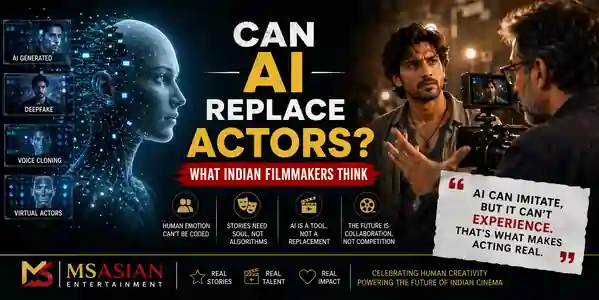
Can AI Replace Actors? What Indian Filmmakers Think | MSAsian Entertainment
Can AI Replace Actors? What Indian Filmmakers Think
The rise of Artificial Intelligence (AI) has disrupted nearly every industry—from healthcare and finance to marketing and content creation. Now, the spotlight is firmly on the entertainment world, where a provocative question is gaining traction:
Can AI replace actors?
With the emergence of AI-generated faces, deepfake technology, voice cloning, and virtual influencers, the line between real and artificial performance is becoming increasingly blurred. In India, one of the world’s largest film industries, this question has sparked intense debate among filmmakers, actors, producers, and audiences alike.
The Rise of AI in Entertainment
Artificial Intelligence is no longer just a futuristic concept—it is already being used in films and media.
Key AI Applications in Cinema:
- De-aging actors (as seen in global films)
- Deepfake face replacement
- Voice cloning for dubbing and reshoots
- Virtual actors and CGI characters
- Scriptwriting assistance
In India, filmmakers have started experimenting with AI in subtle ways. From enhancing VFX to recreating voices of legendary actors, AI is slowly entering the creative pipeline.
But does this mean actors are at risk?
Can AI Truly Replace Actors?
Let’s address the core question directly.
Short answer: Not completely.
While AI can mimic appearance and voice, acting is far more than just visuals and sound. It involves:
- Emotional depth
- Improvisation
- Human experience
- Cultural understanding
AI lacks genuine emotions—it can simulate expressions but cannot feel them.
What Indian Filmmakers Think
Indian filmmakers have mixed opinions on AI replacing actors. Some see it as a powerful tool, while others view it as a threat to creativity and authenticity.
1. AI as a Tool, Not a Replacement
Many directors believe AI should assist—not replace—actors.
They argue:
- AI can reduce production costs
- It can help in post-production (VFX, editing)
- It can recreate scenes without reshoots
However, they strongly emphasize that storytelling still depends on human emotion.
Insight:
Filmmakers see AI as a “support system,” not a “lead performer.”
2. Concerns About Authenticity
Indian cinema thrives on emotional storytelling. Whether it’s Bollywood drama, regional cinema, or OTT content—audiences connect deeply with actors.
Filmmakers worry:
- AI performances may feel robotic
- Emotional scenes may lack depth
- Audience trust could decline
Key concern:
Can an AI make audiences cry, laugh, or feel inspired the same way a real actor can?
Most filmmakers believe the answer is no—at least not yet.
3. Ethical and Legal Challenges
AI introduces serious concerns:
- Deepfake misuse
- Unauthorized use of an actor’s face or voice
- Ownership of digital identity
- Copyright issues
Indian filmmakers are particularly cautious about:
- Actors’ consent
- Data privacy
- Digital rights
Without proper regulations, AI could create more problems than solutions.
4. Cost vs Creativity Debate
Producers may see AI as a cost-cutting opportunity:
- No need for travel, sets, or large crews
- Virtual actors don’t demand fees or contracts
But filmmakers argue:
“Cinema is not just about cost—it’s about connection.”
Replacing actors with AI may reduce expenses but could also reduce the emotional impact of films.
The Human Factor: Why Actors Still Matter
Actors bring something AI cannot replicate—human experience.
What Makes Human Acting Unique:
- Personal struggles and emotions
- Cultural and social understanding
- Spontaneity in performance
- Real chemistry between co-actors
Even the best AI cannot replicate:
- A tear that comes from real emotion
- A pause that reflects inner conflict
- A performance shaped by lived experience
This is why most Indian filmmakers believe actors will remain irreplaceable.
AI Actors: A Glimpse Into the Future
While full replacement may not happen, hybrid models are emerging.
Possible Future Scenarios:
1. AI-Assisted Acting
Actors may use AI tools to enhance performance:
- Voice correction
- Facial enhancement
- Digital doubles for dangerous scenes
2. Virtual Characters
AI-generated characters may appear in:
- Sci-fi films
- Animation
- Gaming crossovers
3. Digital Resurrection
AI could recreate:
- Deceased actors
- Younger versions of stars
This opens new creative possibilities—but also ethical debates.
Impact on Indian Cinema Industry
AI could reshape multiple aspects of the industry:
1. Casting Process
- AI could suggest ideal actors based on scripts
- Virtual auditions may become common
2. Production Efficiency
- Faster editing and post-production
- Reduced reshoot requirements
3. Content Personalization
- AI could tailor films for different audiences
MSAsian Entertainment Perspective
At MSAsian Entertainment, the focus remains on authentic storytelling powered by human creativity.
While AI is recognized as a valuable tool for:
- Enhancing production quality
- Improving efficiency
- Supporting creative workflows
The core belief remains:
“Stories connect through people—not algorithms.”
MSAsian Entertainment emphasizes:
- Real actors
- Real emotions
- Real cultural narratives
AI may support the process, but it cannot replace the soul of storytelling.
Challenges AI Must Overcome
Before AI can even attempt to replace actors, it must solve:
- Emotional intelligence gap
- Cultural sensitivity limitations
- Ethical regulations
- Audience acceptance
Until then, AI remains a tool—not a replacement.
Final Verdict: Can AI Replace Actors?
AI will not replace actors, but it will transform how acting and filmmaking work.
The Reality:
- AI will assist actors
- AI will enhance production
- AI will create new creative possibilities
- But AI will not replace human emotion
Indian filmmakers largely agree:
“Cinema without human actors loses its soul.”
FAQs
1. Can AI completely replace actors in movies?
No. AI can mimic visuals and voice but cannot replicate human emotions, creativity, and real-life experiences.
2. Are Indian filmmakers using AI in films?
Yes, but mostly for VFX, editing, and technical enhancements—not as a replacement for actors.
3. What are the risks of AI in acting?
Major risks include deepfake misuse, copyright issues, lack of consent, and loss of authenticity.
4. Will AI reduce opportunities for actors?
AI may change the industry but is unlikely to eliminate acting jobs. Instead, roles may evolve.
5. Can AI create realistic emotional performances?
Not yet. AI can simulate emotions but lacks genuine human feeling.
6. Is AI acting legal in India?
Currently, laws are still evolving. Consent and digital rights are major concerns.
7. What is the future of AI in Indian cinema?
AI will act as a support tool, enhancing filmmaking rather than replacing actors.
Conclusion
AI is undoubtedly reshaping the entertainment industry, but the idea of it replacing actors entirely remains unrealistic—especially in a country like India, where cinema is deeply emotional and culturally rooted.
Indian filmmakers recognize AI’s potential but also understand its limitations. The consensus is clear: AI can enhance storytelling, but it cannot replace the human heart behind it.
At MSAsian Entertainment, the belief in authentic, human-driven storytelling continues to guide the creative vision—because in the end, audiences connect with emotions, not algorithms.
🔥 Supported by Nav Times News | 🎬 Powered by MS Asian Film Academy | 🚀 Blog by MSAsian Entertainment