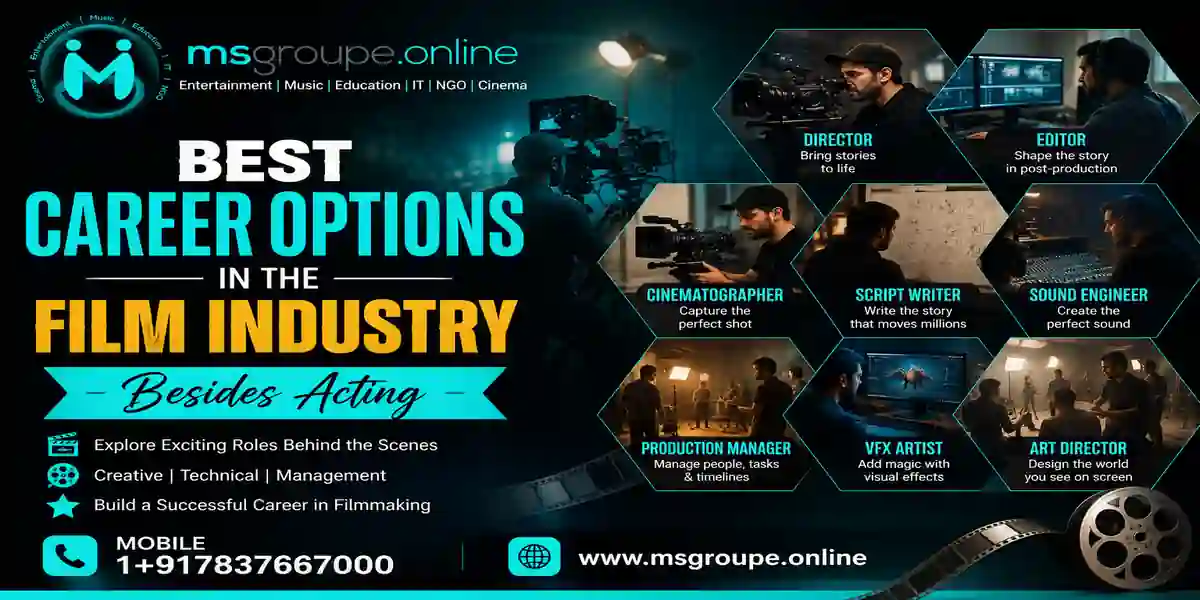
Best Career Options in Film Industry Besides Acting (2026)
Why Consider a Non-Acting Career in Film?
The film industry isn't just about actors — it's a massive collaborative machine involving hundreds of professionals working together on a single project. According to industry estimates, for every actor on a film set, there are anywhere from 50 to 200 crew members involved in production, post-production, marketing, and distribution.
Choosing a non-acting career path offers several advantages:
- Lower competition compared to acting, where thousands audition for a handful of roles
- Multiple career paths within a single vertical (direction, production, editing, VFX, etc.)
- Long-term stability, since technical and creative crew are always in demand
- Global opportunities, as skills like editing, VFX, and sound design are in demand internationally
- Creative satisfaction without the pressure of public visibility
If you love storytelling, visuals, or the technical craft of filmmaking, there's likely a role that fits your strengths perfectly.
1. Film Direction
Film direction is often considered the most powerful creative role after acting. A director is responsible for translating a script into a visual story — guiding actors, working with cinematographers, and making critical creative decisions throughout production.
What a film director does:
- Interprets the script and develops a creative vision
- Directs actors and blocks scenes
- Collaborates with cinematographers, editors, and production designers
- Oversees the overall tone, pacing, and storytelling of the film
Skills required: Strong storytelling instincts, leadership, communication, and a deep understanding of visual grammar.
If direction excites you, a structured film direction course can help you learn everything from script breakdown to shot composition and on-set leadership under the guidance of experienced mentors.
2. Film Production
While directors handle the creative side, producers manage the business and logistics of filmmaking. Without producers, most films would never make it to screens.
What a producer does:
- Manages budgets and financing
- Hires crew and coordinates schedules
- Oversees legal contracts and distribution deals
- Ensures the project stays on time and on budget
Producers are essentially the backbone of any production house, balancing creative ambition with practical execution. This is a career path suited to organized, detail-oriented individuals who enjoy problem-solving under pressure.
A solid grounding in production comes from hands-on training — the kind offered through a dedicated filmmaking course, where students learn production planning alongside other core filmmaking disciplines.
3. Cinematography (Director of Photography)
Cinematographers, also known as Directors of Photography (DOPs), are responsible for the visual look of a film — lighting, camera angles, movement, and composition all fall under their expertise.
What a cinematographer does:
- Chooses camera equipment, lenses, and lighting setups
- Works closely with the director to achieve the desired visual tone
- Manages the camera and lighting crew on set
- Understands color, composition, and movement deeply
Cinematography blends technical knowledge with artistic vision, making it ideal for visually-minded individuals who enjoy working with equipment and light.
4. Film Editing
Editing is where a film truly comes together. Editors take raw footage and shape it into a coherent, emotionally engaging story — deciding pacing, transitions, and structure.
What a film editor does:
- Assembles raw footage into a structured narrative
- Works with sound, color, and visual effects teams
- Makes critical pacing and storytelling decisions in post-production
- Uses industry-standard software like Premiere Pro, Avid, or DaVinci Resolve
Editors often work quietly behind the scenes, but their impact on a film's success is enormous — many industry veterans consider editing the "invisible art" of filmmaking.
5. Sound Engineering and Music Production
Sound is half the cinematic experience, and professionals in this space are always in demand — whether for films, web series, or independent music. Sound engineers and music producers, though related, focus on different aspects: sound engineers handle technical recording and mixing, while music producers oversee the creative and musical direction of a project.
Common roles in this field:
- Sound recordist (on-set audio capture)
- Sound designer (creating ambient and effect sounds)
- Foley artist (recreating everyday sounds for film)
- Music composer/producer (creating original scores and soundtracks)
- Re-recording mixer (final sound mix for theatrical release)
This is a highly technical field with strong career prospects, especially as OTT platforms and independent productions continue to grow across India.
6. Screenwriting
Every film begins with a script. Screenwriters are the storytellers who create characters, dialogue, and narrative structure long before a camera ever rolls.
What a screenwriter does:
- Develops original stories or adapts existing material
- Writes dialogue, scene descriptions, and character arcs
- Collaborates with directors and producers to refine scripts
- Understands three-act structure, pacing, and genre conventions
Screenwriting can be pursued as a full-time career or alongside directing, since many successful filmmakers write their own material.
7. Art Direction and Production Design
Art directors and production designers are responsible for the visual world of a film — sets, props, locations, and overall aesthetic design.
What this role involves:
- Designing sets and selecting locations
- Managing props, costumes coordination, and overall visual continuity
- Working closely with the director and cinematographer to establish tone
- Overseeing art department budgets and teams
This career suits individuals with a strong design sensibility and attention to visual detail.
8. VFX and Animation
With the explosive growth of visual effects in Indian and global cinema, VFX artists and animators are among the most sought-after professionals in the industry today.
Career options in this field include:
- VFX compositor
- 3D animator
- Motion graphics artist
- Rotoscoping and matte painting artist
- CGI supervisor
This is a highly technical, software-driven career path, ideal for those with strong computer skills and artistic vision. Many VFX professionals work remotely or freelance for studios across the world.
9. Casting Director
Casting directors play a crucial, often underappreciated role — they're responsible for finding the right actors for every role in a production.
What a casting director does:
- Auditions and evaluates actors for various roles
- Coordinates with talent agencies and acting schools
- Negotiates contracts with actors and their representatives
- Works closely with directors to match talent with vision
This role requires a sharp eye for talent, strong industry networking skills, and deep familiarity with the acting community.
10. Costume Design and Makeup Artistry
Costume designers and makeup artists shape how characters look and feel on screen, contributing significantly to storytelling through visual transformation.
Key responsibilities include:
- Designing period-accurate or character-specific costumes
- Applying makeup, prosthetics, and special effects makeup
- Collaborating with production designers for visual consistency
- Managing wardrobe continuity throughout shooting
This career combines fashion, design, and artistry, and is especially valuable in an industry increasingly focused on visual authenticity.
11. Film Marketing and Distribution
Once a film is made, it needs an audience — and that's where marketing and distribution professionals come in.
Roles in this space include:
- Film publicist and PR manager
- Digital marketing strategist for entertainment brands
- Distribution manager (theatrical, OTT, satellite rights)
- Social media and content strategist for film promotions
As entertainment companies increasingly rely on digital campaigns to promote films and web series, marketing professionals with an understanding of both cinema and digital strategy are in high demand.
12. Modelling
Modelling is another glamorous, camera-facing career path that overlaps with the film and entertainment world without requiring traditional acting skills. Models work across print, ramp shows, commercials, and digital campaigns — often serving as a stepping stone into television and film as well.
What a modelling career involves:
- Building a professional portfolio
- Ramp walks, print shoots, and brand campaigns
- Developing screen presence and confidence on camera
- Networking with photographers, designers, and casting agents
A structured modelling course can help you build the right foundation — from grooming and ramp walk techniques to portfolio building and industry networking.
How to Start Your Non-Acting Film Career
Breaking into any of these fields requires the right blend of training, networking, and hands-on experience. Here's how you can get started:
1. Get formal training. Structured courses give you technical knowledge, industry exposure, and mentorship that's difficult to gain on your own. Explore the full range of courses at MS Asian Film Academy, covering direction, filmmaking, acting, and modelling.
2. Build a portfolio. Whether it's a showreel, a script sample, or edited footage, having tangible work to show potential employers or collaborators is essential.
3. Network within the industry. Attend film festivals, workshops, and industry events. Many opportunities in film come through personal connections and referrals.
4. Gain hands-on set experience. Internships or assistant roles on film sets provide invaluable real-world learning that no classroom can fully replicate.
5. Stay updated with industry trends. The rise of OTT platforms, digital marketing, and VFX technology means the industry is constantly evolving — staying current gives you a competitive edge.
If you're exploring which path suits you best, you can also learn more about the different creative and business verticals under MS Groupe, which spans production, filmmaking, acting education, and entertainment company services — giving aspiring professionals multiple entry points into the industry.
Frequently Asked Questions
Q1: What is the best career option in the film industry besides acting?
There's no single "best" option — it depends on your interests. If you love visual storytelling, direction or cinematography may suit you. If you're detail-oriented and organized, production or editing could be a better fit. If you enjoy sound, music production or sound engineering is a strong path.
Q2: Do I need a film degree to work in the film industry?
A formal degree isn't mandatory, but specialized training through recognized courses significantly improves your technical skills, industry knowledge, and networking opportunities compared to learning entirely on your own.
Q3: Which film industry career has the highest demand right now?
VFX, editing, and digital content creation roles are currently among the highest in demand due to the growth of OTT platforms, web series, and digital-first content production.
Q4: Can I switch from acting to a technical or creative film role?
Yes, many professionals transition between roles. Actors often move into direction, writing, or production once they gain industry experience and develop a broader understanding of filmmaking.
Q5: How long does it take to build a career in filmmaking?
This varies by role. Technical skills like editing or VFX can take 6 months to 2 years to master through structured courses, while roles like directing or producing often require several years of hands-on experience alongside formal training.
Q6: Is modelling considered a film industry career?
Yes, modelling overlaps significantly with the entertainment industry and often serves as a gateway into television, commercials, and even film roles, especially for those building screen confidence and industry connections.
Ready to Build Your Career in Film?
Whether you're drawn to direction, filmmaking, modelling, or acting itself, the right training can make all the difference in launching a successful career in the entertainment industry. At MS Asian Film Academy, part of the MS Groupe family of companies — spanning a production house, filmmaking studio, acting school, and entertainment company services — we offer specialized courses designed to prepare you for real-world industry demands.
Explore our acting course, film direction course, filmmaking course, or modelling course to find the path that matches your ambitions. Learn more about our journey and mission on our About Us page, or browse our full range of services.
📞 Call us now at +91 7837667000 to speak with our career counselors, or reach out through our Contact Us page to get started on your journey into the film industry today.
🔥 Supported by Nav Times News | 🎬 Powered by MS Asian Film Academy | 🚀 Blog by MSAsian Entertainment