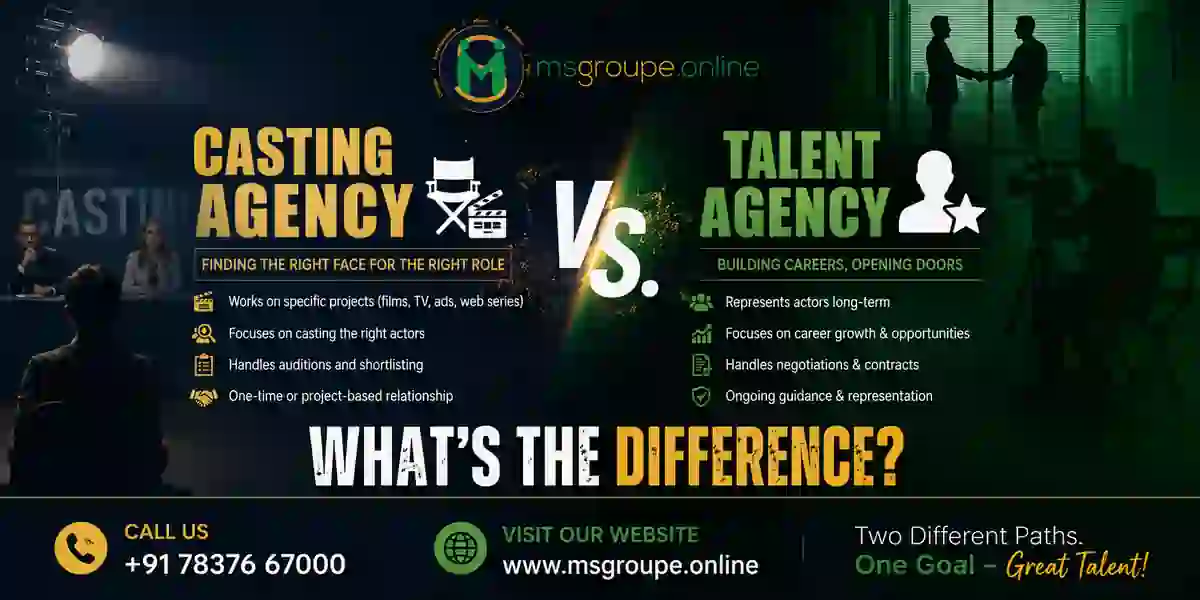
Casting Agency vs. Talent Agency — What's the Difference?
If you're an aspiring actor, a filmmaker, or a brand looking for the right face to represent your project, you've probably heard the terms "casting agency" and "talent agency" used interchangeably. But here's the truth: they are not the same thing.
Understanding the difference between a casting agency and a talent agency can save you months of confusion, misdirected applications, and missed opportunities. Whether you're an actor trying to land your first role or a producer trying to staff your next film, knowing who does what in the entertainment industry is the first step toward success.
In this guide, we'll break down exactly what a casting agency does, what a talent agency does, how they work together, and which one you actually need. We'll also show you how MS Groupe, a full-service entertainment company, bridges this gap by offering casting, talent management, production, and acting training all under one roof.
Let's dive in.
What Is a Casting Agency?
A casting agency is a specialized service that works on behalf of productions—films, TV shows, web series, commercials, music videos, and theatre—to find the right actors for specific roles.
Casting agencies are hired by production houses, directors, or producers. Their job is to:
- Review scripts and character breakdowns
- Source and shortlist actors who match the role
- Organize auditions and callbacks
- Negotiate contracts on behalf of the production
- Coordinate schedules between actors and the shoot
In short, a casting agency works for the project, not for the actor. Their client is the production. Actors who audition through a casting agency are essentially applying for a job, similar to how a recruitment agency fills a corporate vacancy.
Casting agencies typically work on a project-by-project basis. Once the roles for a particular film or show are filled, their job for that project is done. They may not have an ongoing relationship with the actors they cast unless another project comes along that needs similar talent.
Key Traits of a Casting Agency
- Works directly with production houses and filmmakers
- Focuses on filling specific roles for specific projects
- Engagement is temporary and project-based
- Does not typically manage an actor's long-term career
- Paid by the production, not by the actor
What Is a Talent Agency?
A talent agency, on the other hand, represents individual performers—actors, models, dancers, singers, and other artists—on an ongoing basis. Their client is the talent, not the production.
A talent agency's core responsibilities include:
- Building and managing an actor's portfolio and career
- Actively pitching talent to casting directors and production houses
- Negotiating contracts, fees, and terms on the talent's behalf
- Advising on career direction, branding, and image
- Securing auditions across multiple projects over time
Unlike a casting agency, a talent agency's relationship with an actor is long-term. Agencies often take a commission (typically 10-20%) from the earnings they help secure for their clients. Their success is tied directly to how well their talent performs and how much work they can land for them.
Key Traits of a Talent Agency
- Represents actors, models, and performers directly
- Manages long-term career growth and bookings
- Actively markets talent to multiple productions
- Earns commission from the talent's income
- Provides guidance beyond just casting—branding, negotiation, and career strategy
Casting Agency vs. Talent Agency: The Core Difference
Here's the simplest way to remember it:
A casting agency works for the project. A talent agency works for the person.
| Feature | Casting Agency | Talent Agency |
|---|---|---|
| Who they represent | The production | The actor/artist |
| Relationship length | Project-based, short-term | Ongoing, long-term |
| Who pays them | Production house | Commission from talent's earnings |
| Main goal | Fill roles quickly and accurately | Grow the actor's career over time |
| Actor's involvement | Auditions for a specific role | Represented across multiple opportunities |
This distinction matters because it changes how actors, filmmakers, and even production houses should approach each type of agency.
Why This Distinction Matters for Actors
If you're an actor trying to break into the industry, understanding this difference shapes your entire strategy.
If you register with a casting agency, you're putting yourself in the running for specific roles as they come up. There's no guarantee of ongoing representation—you're essentially one of many candidates being considered for a job opening.
If you sign with a talent agency, you get a dedicated team actively pitching you for multiple opportunities, negotiating your rates, and helping you build a sustainable acting career. This is a more strategic, long-term investment in your growth as a performer.
Many successful actors work with both. A talent agency manages their overall career, while casting agencies bring them into specific projects that fit their profile.
Why This Distinction Matters for Filmmakers and Production Houses
If you're a filmmaker or run a production house, knowing the difference helps you staff your project efficiently.
Need to fill ten speaking roles and thirty background artists for a feature film within three weeks? A casting agency is built exactly for this. They have databases, networks, and processes designed to move fast and match actors to roles precisely.
Need an established face to headline your project or add credibility to your cast? That's where a relationship with talent agencies becomes valuable, since they represent the actors you actually want to book.
Smart productions use both: casting agencies to manage the process, and talent agencies to access represented performers.
How MS Groupe Bridges Both Worlds
Most companies in the entertainment space pick a lane—they're either a casting agency or a talent agency, not both. MS Groupe takes a different approach.
As a full-service entertainment company, MS Groupe operates as:
- A casting agency that partners with production houses to source and shortlist the right actors for films, shows, and commercials
- A talent agency that represents and grows the careers of actors, models, and performers
- A production house that develops and executes film and content projects from concept to screen
- A partner to independent filmmakers looking for casting support, production resources, or creative collaboration
- An acting school that trains the next generation of performers with industry-relevant skills
This integrated model means actors trained at the MS Groupe acting school can be represented by the talent agency arm, and then cast directly into productions handled by the casting and production divisions. Filmmakers get access to a trained, ready pool of talent along with full production support—all without juggling multiple vendors.
What This Means for You
If you're an actor: You get training, representation, and casting opportunities in one ecosystem instead of navigating three separate companies.
If you're a filmmaker or producer: You get casting support, production resources, and access to trained talent—streamlined under one point of contact.
If you're a brand or business: You get access to vetted talent for commercials, brand campaigns, and content projects, backed by a production team that understands execution.
Common Myths About Casting and Talent Agencies
Myth 1: "Casting agencies and talent agencies do the same job."
False. One works for productions; the other works for performers. Confusing the two often leads actors to submit to the wrong channel for the opportunity they're seeking.
Myth 2: "You only need one or the other."
Not true for most working actors. Long-term career growth usually requires talent representation, while casting agencies provide the actual project opportunities that representation helps you access.
Myth 3: "Talent agencies guarantee work."
No agency can guarantee bookings. What a good talent agency guarantees is active effort, industry access, and professional negotiation on your behalf.
Myth 4: "Casting agencies charge actors money to get roles."
Legitimate casting agencies are paid by the production, not the actor. Be cautious of any casting or talent service that asks for large upfront fees before offering any real opportunity.
How to Choose the Right Agency for Your Goals
Before reaching out to any agency, ask yourself these questions:
- Am I looking for a single opportunity or long-term representation? If it's one project, a casting call might be enough. If you want sustained career growth, look for talent representation.
- Does the agency have a verifiable track record? Look at past productions, client testimonials, and industry reputation.
- Is the agency connected to real production work? Agencies linked to active production houses—like MS Groupe—often provide more consistent access to opportunities.
- Do they offer training or skill development? An agency connected to an acting school gives you a pathway to improve, not just apply.
- Are their terms transparent? A trustworthy agency will be upfront about commissions, contracts, and expectations.
Frequently Asked Questions (FAQs)
Q1: Is a casting agency the same as a talent agency?
No. A casting agency works for productions to fill specific roles, while a talent agency represents actors and manages their careers over the long term.
Q2: Can an actor work with both a casting agency and a talent agency at the same time?
Yes. In fact, many professional actors do exactly this—a talent agency manages their overall career while casting agencies bring project-specific opportunities.
Q3: Do talent agencies charge actors money?
Legitimate talent agencies typically earn a commission (usually 10-20%) from the work they secure for the actor, rather than charging upfront fees.
Q4: How do I know if a casting call is legitimate?
Check whether the casting agency is linked to a known production house or entertainment company, review their past projects, and be wary of any request for large advance payments.
Q5: What should a new actor do first—join an acting school, a talent agency, or a casting agency?
Starting with proper acting training builds the foundation. From there, talent representation and casting opportunities become far more accessible and effective.
Q6: Does MS Groupe work with both actors and filmmakers?
Yes. MS Groupe operates as a casting agency, talent agency, production house, and acting school—supporting actors, filmmakers, and entertainment brands under one integrated platform.
Final Thoughts
The difference between a casting agency and a talent agency comes down to one simple question: who are they working for?
Casting agencies serve productions, helping fill roles quickly and accurately. Talent agencies serve performers, building and managing their careers over time. Both play essential, complementary roles in the entertainment industry—and understanding this difference is the first step toward making smarter decisions, whether you're in front of the camera or behind it.
At MS Groupe, we've built a model that removes the guesswork. As a casting agency, talent agency, production house, and acting school combined, we support actors, filmmakers, and entertainment companies at every stage—from training and representation to casting and full-scale production.
Ready to Take the Next Step?
Whether you're an actor looking for representation, a filmmaker searching for the perfect cast, or a brand looking to produce standout content—MS Groupe is your one-stop entertainment partner.
📞 Call us now at +91 7837667000
🌐 Visit us at www.msgroupe.online
Get in touch today and let's bring your next project to life—whether it's casting, talent management, production, or acting training.
MS Groupe — Casting Agency | Talent Agency | Production House | Acting School | Entertainment Company
🔥 Supported by Nav Times News | 🎬 Powered by MS Asian Film Academy | 🚀 Blog by MSAsian Entertainment