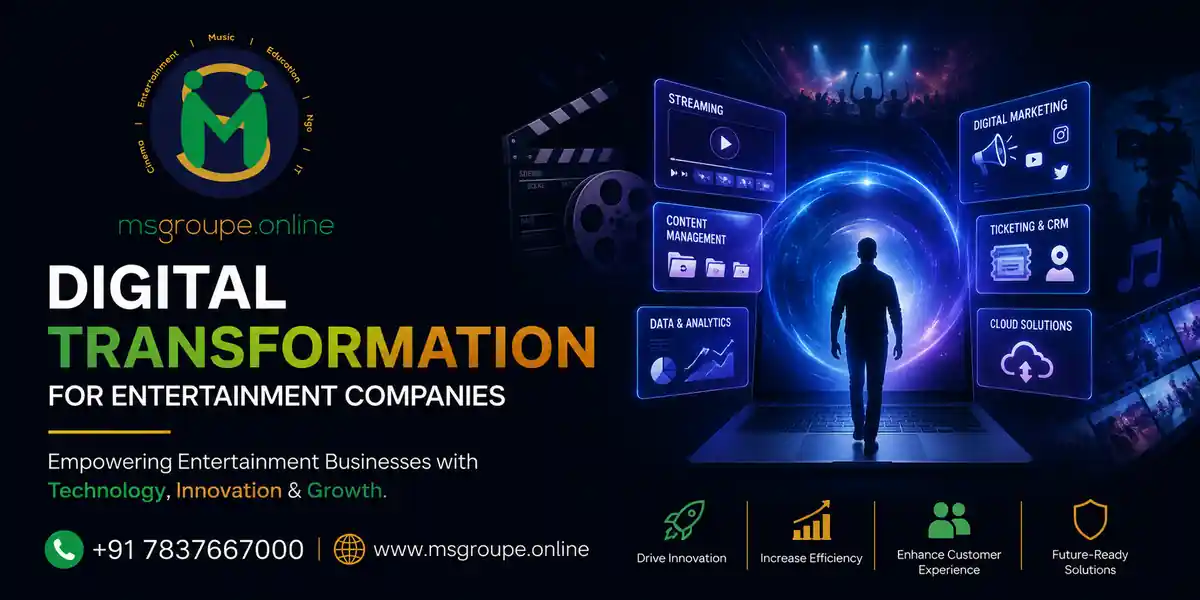
Digital Transformation for Entertainment Companies | MSAFA
Walk into any film set today and you'll notice something that would have looked out of place ten years ago — a director checking dailies on a tablet between takes, an assistant tagging footage with AI-assisted metadata, a casting call that went out on Instagram before it ever hit a WhatsApp group. The entertainment business hasn't just adopted new tools. It has quietly rewired how films get made, how actors get trained, and how audiences discover both.
For a company like Msasian Entertainment, which operates across production, filmmaking, and actor training under one roof, this shift isn't theoretical. It shapes daily decisions — which platforms to shoot for, how students are taught camera technique, and how a finished project actually reaches an audience. This piece looks at what digital transformation really means for entertainment businesses in 2026, and why companies that treat it as a checklist item rather than a mindset tend to fall behind.
What "Digital Transformation" Actually Means in Entertainment
The phrase gets thrown around so often that it's lost some of its meaning. For a production house, it isn't just about owning good cameras or editing software — most studios cleared that bar years ago. Real transformation touches four layers of the business at once:
- Production workflows — pre-visualization, virtual sets, cloud-based editing, and remote collaboration between departments that used to require everyone in the same room.
- Talent development — how actors, directors, and technicians are trained, with hybrid and online formats sitting alongside traditional studio-based coaching.
- Distribution and discovery — where a film or short actually reaches its audience, which increasingly means OTT platforms, YouTube, and short-form social content rather than theatrical release alone.
- Business operations — everything from client onboarding and contracts to marketing, which now runs largely through data-driven, SEO-informed content rather than print ads or word of mouth.
A company that upgrades one of these layers without touching the others usually ends up with a bottleneck. A studio can shoot in 4K and still lose an audience if its distribution strategy hasn't caught up. An acting school can have brilliant instructors and still lose enrollment if prospective students can't find it online.
Production Houses: From Physical Sets to Cloud-Based Workflows
Production has arguably changed the most. A decade ago, a film's post-production pipeline lived on a single hard drive in an editing suite. Today, editors, colorists, and sound designers frequently work from different cities, sometimes different countries, syncing through cloud storage and shared project files.
This matters practically for a production house's bottom line. Remote collaboration cuts down on travel and studio rental costs. Cloud rendering means a smaller studio doesn't need to own a render farm to compete with bigger players. And pre-visualization tools — where a director can block out a scene digitally before a single actor steps on set — save shooting days, which is often the single biggest line item in a budget.
There's also a quieter shift happening around AI-assisted tools in editing and VFX. Rotoscoping, color matching, and even rough-cut assembly can now be partially automated, freeing editors to spend their time on the creative decisions that actually need a human eye. None of this replaces craft — if anything, it raises the floor, so smaller production houses can produce work that looks and sounds comparable to much bigger budgets.
Acting Schools and Talent Training: The Hybrid Classroom Era
Training actors has traditionally meant one thing: a physical studio, a live instructor, and scene work in front of peers. That core hasn't disappeared, and it shouldn't — there's no substitute for feedback on stage presence, voice projection, or on-camera timing that comes from being in the room. But the surrounding structure has changed considerably.
Recorded masterclasses, hybrid batches that mix in-person workshops with online theory sessions, and digital portfolios that let a student build a demo reel as they train — these have become standard expectations rather than nice-to-haves. Prospective students researching acting classes near me in Chandigarh or comparing the best acting school in India are doing that research almost entirely online, reading course pages, watching sample lessons, and checking placement outcomes before they ever walk into a campus.
This is where a school's digital presence stops being marketing and starts being part of the actual educational product. A well-structured acting course page, for instance, tells a prospective student exactly what a term of training looks like, what skills they'll walk away with, and what kind of placement support follows. The same applies across disciplines — a film direction course, a filmmaking course, or a modelling course each need their own clear, honest description of outcomes, not a generic template repeated across pages.
Schools that treat this as digital transformation — not just "having a website" — tend to see it reflected in enrollment quality. Students arrive with realistic expectations, having already understood what a top acting school in India actually offers versus what it markets.
Distribution: Where the Audience Actually Lives Now
Even a beautifully produced film goes nowhere without the right distribution strategy, and this is probably the area where entertainment businesses have had to unlearn the most. Theatrical release used to be the finish line. Now it's often just one channel among several — OTT licensing, YouTube monetization, festival circuits, and social-first short content each serve different purposes and different audiences.
A short film aimed at a festival run needs a completely different marketing runway than a branded content piece meant to go viral on Instagram Reels within 48 hours. Production houses that understand this early — building distribution strategy into pre-production rather than bolting it on after the edit is locked — tend to get more mileage out of every project they finish.
This is also where data starts to matter in ways it didn't before. Audience retention graphs on a streaming platform, watch-time data on YouTube, engagement patterns on social clips — these aren't vanity numbers. They tell a production house what's actually resonating, which shapes decisions on the next project long before a script is finalized.
Marketing and Discoverability: SEO, AEO, and Answer Engines
Here's a piece of digital transformation that often gets underestimated in entertainment: how a company gets found in the first place. Ten years ago, reputation traveled through industry word of mouth and print coverage. Today, someone searching for a drama school or theatre classes is typing that query into Google, and increasingly, asking an AI assistant the same question directly.
This is why search engine optimization and answer engine optimization now sit side by side. Ranking well on Google still matters, but so does being the source that an AI-powered answer engine pulls from when someone asks "which acting school in India has strong placement support?" Both depend on the same underlying discipline: clear, genuinely useful content that answers real questions, backed by credible expertise, experience, authoritativeness, and trust — the E-E-A-T framework search engines now weigh heavily.
For an entertainment company, that means course pages, blog content, and service pages need to do more than list offerings. They need to demonstrate lived experience — actual placement outcomes, actual production credits, actual instructor backgrounds — because that's what both search algorithms and real prospective clients are looking for.
Bringing It Together: A Multi-Vertical Approach
What makes this especially relevant for a company structured the way Msasian Entertainment is — spanning production, filmmaking, and actor training — is that digital transformation across one vertical strengthens the others. A well-produced student showreel becomes marketing content for the acting school. A production house's client work becomes a credibility signal for prospective students researching 100% placement claims. A strong online presence for one vertical lends trust to the next.
You can see this reflected across MS Groupe's verticals — courses, production work, and modelling training all under one umbrella, each reinforcing the others rather than operating in silos. It's worth exploring the full range of courses offered if you're evaluating training options, since the strength of a multi-vertical entertainment company often shows up most clearly in how consistently its different arms support one another.
None of this works, though, without genuine transparency about who the company is and what it actually offers. Digital transformation built on hollow marketing claims tends to collapse the moment a client or student does five minutes of research. Built on real outcomes, it compounds — each project, each graduating batch, each piece of honest content adding to a track record that's genuinely searchable and verifiable online.
Practical Steps for Entertainment Companies Starting This Journey
If you're running a production house, acting school, or entertainment business and wondering where to start, a few starting points tend to matter more than the rest:
- Audit your online presence honestly. Can someone searching for your services actually find clear, specific information, or does your site lean on generic stock descriptions?
- Invest in workflow tools before flashy tech. Cloud storage, shared editing pipelines, and project management tools often deliver more day-to-day value than the latest AI gimmick.
- Treat your website as a training and portfolio tool, not just a brochure. Course pages, sample work, and instructor credentials should read like evidence, not advertising copy.
- Track distribution data from day one. Even a small production house benefits from knowing where its audience actually engages.
- Don't neglect the human element. Technology should support instructors, editors, and directors — not replace the judgment that makes their work good in the first place.
Where Msasian Entertainment Fits In
Msasian Entertainment operates precisely at this intersection — a production house, a filmmaking and acting academy, and a broader entertainment company built to support talent from first audition to finished screen credit. If you're evaluating training options, MS Asian Film Academy offers structured courses across acting, direction, filmmaking, and modelling, each designed around real industry placement outcomes rather than theoretical instruction alone.
For production and entertainment services more broadly, you can explore what MS Groupe offers or learn more about the company and the verticals it operates across.
Digital transformation in entertainment isn't a one-time project you finish and move on from. It's an ongoing habit — one that shows up in how a production house edits, how a school teaches, and how both eventually find the people who need them.
Have a project, a training query, or a partnership in mind? Reach out to Msasian Entertainment directly at +91 7837667000, or get in touch through the contact page to talk through what digital transformation could look like for your part of the entertainment business.
🔥 Supported by Nav Times News | 🎬 Powered by MS Asian Film Academy | 🚀 Blog by MSAsian Entertainment