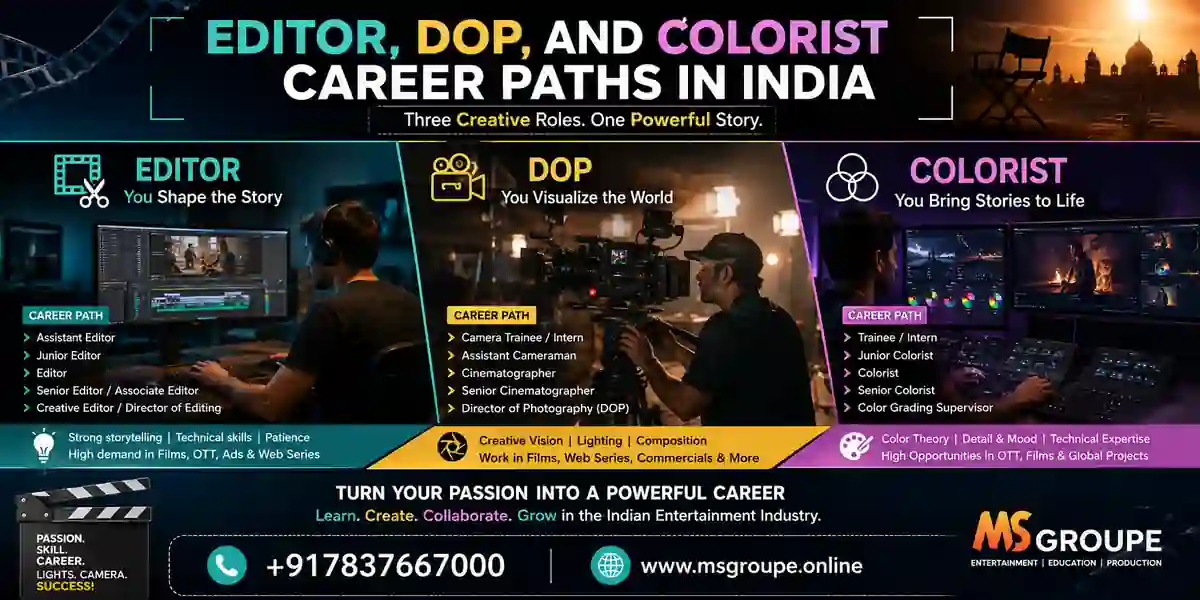
Editor, DOP & Colorist Career Paths in India | MSasian Entertainment
Why Behind-the-Camera Careers Are Booming in India
The Indian content industry isn't just about Bollywood anymore. Regional cinema, web series, branded content, YouTube productions, and independent films have created a massive, ongoing demand for technical crew. A few reasons this shift matters for career seekers:
- OTT platforms commission hundreds of hours of original content every year, each requiring editors, DOPs, and colorists.
- Corporate and brand video production has grown into its own industry, offering steady, well-paying work outside traditional film sets.
- Technology has lowered the entry barrier. Professional-grade cameras, editing software, and color grading tools are more accessible than ever, meaning talent and training matter more than expensive equipment ownership.
- Freelance and project-based work is now a legitimate, sustainable career model, not just a stopgap.
This means there has never been a better time to build a serious, skill-based career in one of these three specializations.
Career Path 1: Film & Video Editor
What Does an Editor Do?
An editor takes raw footage and shapes it into a coherent, emotionally resonant story. This involves selecting the best takes, controlling pacing, syncing sound, adding transitions, and collaborating closely with the director to realize their creative vision. Editors work across film, television, web series, advertisements, and digital content.
Skills Required
- Proficiency in editing software such as Adobe Premiere Pro, Final Cut Pro, or DaVinci Resolve
- A strong sense of rhythm, timing, and narrative structure
- Basic understanding of sound design and color correction
- Patience and attention to detail — editing is often a long, iterative process
- Collaboration and communication skills to work with directors and producers
Career Progression & Salary
Most editors begin as assistant editors, handling footage organization and basic cuts under supervision. With experience, they progress to lead editor roles on independent projects, and eventually to senior editor or post-production supervisor positions overseeing entire projects.
Entry-level editors in India typically start in a modest monthly range, with earnings rising substantially as they build a portfolio and reputation. Senior editors working on OTT originals, feature films, or high-value branded content can command significantly higher project-based fees. Freelance editors often earn more per project than salaried ones once they have an established client base.
Career Path 2: Director of Photography (DOP)
What Does a DOP Do?
The Director of Photography, also called the cinematographer, is responsible for the visual language of a film or video — camera angles, lighting, lens choices, and overall composition. The DOP works hand-in-hand with the director to translate the script's emotional tone into visuals, and manages the camera and lighting crew on set.
Skills Required
- Deep technical knowledge of cameras, lenses, and lighting equipment
- A strong visual and artistic eye for composition and framing
- Understanding of exposure, depth of field, and how different formats affect storytelling
- On-set leadership skills, since the DOP typically manages a full camera and lighting department
- Physical stamina, as shoots can involve long hours and demanding locations
Career Progression & Salary
DOPs almost always start as camera assistants or focus pullers, learning the technical fundamentals on real sets before operating a camera independently. The next step is typically camera operator, followed by DOP on smaller independent or corporate projects, and eventually feature films or big-budget OTT series.
Because cinematography is such a specialized, high-responsibility role, experienced DOPs on commercial and film projects in India can earn considerably more than entry-level crew — often on a per-project or per-day basis rather than a fixed salary. Building a strong portfolio (called a "reel") and networking with directors and producers is critical to career growth in this field.
Career Path 3: Colorist
What Does a Colorist Do?
Colorists work in post-production to grade and correct the color of footage, giving a project its final visual mood and consistency. This has become one of the fastest-growing specializations in Indian film and OTT production, since color grading is now recognized as essential to a project's final quality rather than an optional finishing touch.
Skills Required
- Mastery of color grading software, primarily DaVinci Resolve
- A trained eye for color theory, tone, contrast, and visual storytelling
- Technical understanding of color spaces, LUTs, and delivery formats for different platforms
- Strong communication skills to interpret a director's or DOP's creative vision
- Attention to consistency across long-form projects with hundreds of shots
Career Progression & Salary
Colorists usually begin as assistant colorists or junior post-production technicians, learning grading workflows and software under a senior colorist. With experience, they move into independent colorist roles for short films, ad campaigns, and web series, eventually working on feature films and OTT originals.
Colorists are currently in high demand relative to the number of trained professionals in India, which has pushed skilled colorist fees upward — particularly for those who can demonstrate a strong show reel and consistent, reliable turnaround on projects.
How to Choose the Right Path for You
If you're unsure which of these three paths suits you best, consider the following:
- Choose editing if you're drawn to storytelling, pacing, and shaping narrative after the shoot is over.
- Choose cinematography (DOP) if you're passionate about visual composition, lighting, and being hands-on during production itself.
- Choose color grading if you have a strong eye for tone and mood, and enjoy detailed, focused technical work in post-production.
All three paths reward formal training combined with hands-on project experience — theory alone rarely leads to industry-ready skills.
How MS Groupe and Msasian Entertainment Can Help You Start
Msasian Entertainment operates across two complementary arms to support exactly this kind of career journey:
MS Groupe is a full-scale production house, filmmaker services provider, and entertainment company, offering real production environments where editors, DOPs, and colorists can gain hands-on project experience. Explore our verticals and services to see the range of productions we work on.
MS Asian Film Academy (MSAFA) offers structured, industry-aligned training for those starting from scratch. While MSAFA is best known for its acting course, it also offers a dedicated film direction course and filmmaking course that cover editing, cinematography, and on-set production fundamentals — the essential groundwork for a DOP, editor, or post-production career. Browse all courses, including our modelling course if you're exploring the wider entertainment industry.
Together, these two arms mean you don't have to choose between learning the craft and getting real project experience — MSAFA builds your foundation, and MS Groupe gives you a platform to apply it professionally.
Frequently Asked Questions
Q1: Do I need a film school degree to become an editor, DOP, or colorist in India?
A formal degree isn't mandatory, but structured training significantly speeds up your learning curve and helps you build a professional network. Many successful editors, DOPs, and colorists in India combine short-term specialized courses with hands-on assisting work on real sets.
Q2: Which of these three careers pays the most in India?
Earnings vary widely by experience, project scale, and specialization rather than by career path alone. Experienced DOPs and colorists working on feature films or OTT originals typically earn the highest project-based fees, but all three paths offer strong growth potential with the right skills and portfolio.
Q3: Can I start as an editor and later switch to becoming a DOP or colorist?
Yes. It's common for post-production professionals to move between related specializations, especially between editing and color grading, since both are software-based post-production skills. Moving into cinematography usually requires more on-set, camera-specific experience.
Q4: How long does it take to become job-ready in these fields?
With focused training and consistent practice, many students become ready for assistant-level roles within six months to a year. Reaching an independent, lead-level position typically takes two to four years of active project experience.
Q5: Does MS Groupe hire editors, DOPs, and colorists for real projects?
Yes. As an active production house and filmmaker services company, MS Groupe regularly works with editors, cinematographers, and colorists across its productions. Contact us to discuss opportunities.
Ready to Build Your Career Behind the Camera?
Whether you want to master editing, step behind a professional camera as a DOP, or shape a film's visual mood as a colorist, the right training and real production exposure make all the difference. MS Groupe and Msasian Entertainment give you both.
📞 Call us at +91 7837667000 to speak with our team about training pathways and project opportunities.
👉 Explore our verticals | View our services | About MS Groupe | Get in touch
Looking to start with formal training? Explore acting, film direction, filmmaking, and modelling courses at MS Asian Film Academy.
🔥 Supported by Nav Times News | 🎬 Powered by MS Asian Film Academy | 🚀 Blog by MSAsian Entertainment