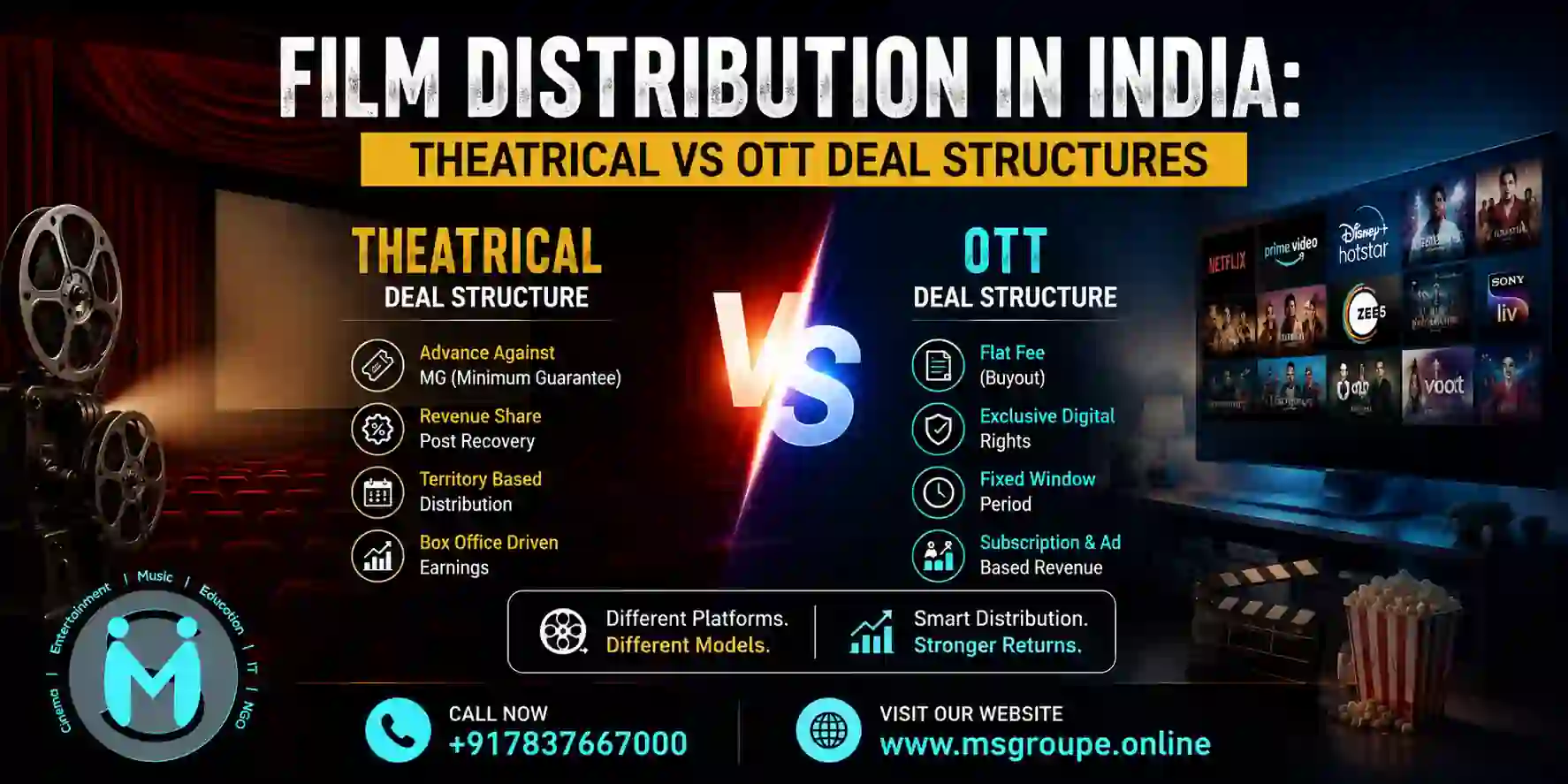
Film Distribution in India: Theatrical vs OTT Deal Structures
Film distribution in India has changed more in the last five years than it did in the previous three decades. Where a film's fate was once decided almost entirely by its opening weekend box office, filmmakers today have a genuine choice: release theatrically, sell to an OTT platform, or pursue a hybrid strategy combining both. Each path comes with its own deal structures, revenue models, risks, and long-term implications for a film's life cycle.
For independent filmmakers, production houses, and even established studios, understanding these distribution structures isn't optional anymore, it's central to how a film gets financed, marketed, and ultimately valued. At MS Groupe, an entertainment company with production, filmmaking, and talent-development verticals under one roof, we work closely with filmmakers navigating exactly this decision. This article breaks down how theatrical and OTT deal structures actually work in India, and how to think about choosing between them.
Why Distribution Strategy Matters More Than Ever
A film's distribution strategy is no longer a decision made after the film is shot. Increasingly, it shapes decisions made at the script stage, budget stage, and casting stage. A film destined for theatrical release needs a different pacing, scale, and marketing runway than one built for an OTT audience scrolling through a home screen. Understanding this upfront helps filmmakers avoid the common trap of shooting a film with one distribution model in mind, only to discover mid-production that the other model would have served it better.
This is one of the first things we address with filmmakers who work with our production house, because a mismatched distribution strategy can quietly erode a film's commercial and creative potential before a single frame is edited.
Understanding Theatrical Distribution Deal Structures
1. The Traditional Distributor Model
In India's theatrical ecosystem, most films are released through a distributor who buys territorial rights from the producer. India is typically divided into distribution territories (Mumbai, Delhi-UP, East Punjab, Nizam, Mysore, and others), and distributors bid for the rights to release a film in their assigned territory.
Under this model, the distributor pays the producer either a flat minimum guarantee (MG) upfront, or works on a revenue-sharing basis where box office collections are split after theater commissions and distributor costs are deducted. Minimum guarantee deals reduce the producer's risk but also cap their upside if the film performs exceptionally well.
2. Prints and Publicity (P&A) Costs
Theatrical releases require significant spending on prints and advertising, commonly called P&A costs. This includes digital cinema package (DCP) creation, marketing campaigns, trailer releases, and promotional events. These costs are typically negotiated separately from the distribution rights fee and can sometimes exceed the film's actual production budget for wide releases.
3. Box Office Revenue Split
Once a film releases, the exhibitor (cinema chain or single-screen owner) takes a percentage of ticket revenue, followed by entertainment tax and GST deductions (where applicable), before the remaining amount is split between the distributor and producer based on their negotiated agreement. This is why a film can appear to be a "hit" in terms of audience turnout but still underperform financially for the producer, because so many parties take a share before profits reach the production house.
4. Satellite and Music Rights Bundled In
Many theatrical deals also bundle in satellite (TV broadcast) rights and music rights as part of the overall package, sold separately to television networks and music labels. For a mid-budget Indian film, satellite and music rights can sometimes recover a significant portion of the production cost even before the theatrical release happens, providing a financial cushion regardless of box office performance.
Understanding OTT Deal Structures
1. Direct Acquisition (Outright Sale)
The most common OTT deal structure for smaller and mid-budget films is a straightforward acquisition: the platform pays the producer a fixed amount for exclusive streaming rights, usually for a defined period (often five to ten years), sometimes in perpetuity. This is attractive to producers because it offers guaranteed revenue with zero box office risk. However, it also means the producer gives up any further upside if the film becomes a major hit on the platform, since most acquisition deals don't include performance-based bonuses.
2. Theatrical-First, OTT-Later Windowing
Many larger productions still release theatrically first and then license the film to an OTT platform after a "window" period, typically four to eight weeks post-theatrical release. This structure allows producers to capture box office revenue and prestige from a theatrical run, then follow it up with a separate OTT licensing deal, often negotiated in advance but activated only after the theatrical window closes.
3. OTT Originals and Production Partnerships
Increasingly, OTT platforms are directly commissioning films and series as originals, funding the entire production budget in exchange for full ownership of the content. In these deals, the platform typically owns all rights outright, and the production house or filmmaker is paid a production fee plus, in some cases, a backend bonus tied to viewership metrics or awards recognition. This model shifts financial risk almost entirely onto the platform, but also limits the producer's long-term ownership and profit-sharing potential.
4. Revenue-Share and Hybrid OTT Models
A smaller but growing segment of OTT deals involves revenue-sharing arrangements, where the platform and producer split subscription-driven or ad-driven revenue based on actual viewership data (often measured through internal analytics the platform shares selectively). These deals are less common because platforms are generally reluctant to share detailed viewership data, but they are becoming more standard for regional-language content and platforms competing aggressively for regional audiences.
Comparing Theatrical and OTT: Key Differences Filmmakers Should Know
Revenue Timing: Theatrical revenue arrives over a period of weeks, dependent on daily box office collections, while OTT acquisition deals typically pay a lump sum upfront or in structured tranches, offering more predictable cash flow.
Risk Exposure: Theatrical releases carry significant risk, box office failure due to poor reviews, competing releases, or even external factors like weather or regional disruptions can drastically affect returns. OTT acquisition deals shift much of this risk to the platform, since payment isn't tied to how many people actually watch the film.
Audience Reach and Longevity: A theatrical release generates concentrated buzz over a short window, while an OTT release offers longer-tail discoverability, viewers can find and watch the film months or years after release, extending its cultural relevance.
Prestige and Awards Eligibility: Certain film festivals and awards (including some categories at national and international festivals) require a theatrical release for eligibility, making theatrical distribution important for filmmakers pursuing critical recognition alongside commercial success.
Marketing Cost Burden: Theatrical releases demand heavy upfront marketing spend to drive opening weekend footfall, while OTT releases often rely more on the platform's own promotional push and algorithmic discovery, reducing the producer's direct marketing burden.
How Filmmakers Should Approach the Decision
There's no universally "better" choice between theatrical and OTT distribution, the right structure depends on the film's genre, budget, target audience, and the filmmaker's long-term goals. A high-concept commercial film with strong star power and mass appeal often benefits from a theatrical-first strategy to maximize opening weekend buzz. A niche, performance-driven, or festival-oriented film may find a more receptive and appreciative audience through direct OTT acquisition, especially if theatrical distribution would mean competing against bigger releases for limited screens.
This is exactly the kind of strategic decision-making we guide filmmakers through at MS Groupe. As a full-fledged entertainment company spanning production, filmmaking services, and talent development, we help filmmakers evaluate their film's commercial positioning before committing to a distribution path. You can learn more about our end-to-end services for filmmakers and production partners, or explore our different business verticals to see how we support projects at every stage.
Negotiating Better Deal Terms: What Filmmakers Often Miss
Many first-time and independent filmmakers focus heavily on the headline number in a distribution deal, the minimum guarantee or acquisition fee, without paying close enough attention to the finer contractual details that affect long-term value. A few commonly overlooked terms include:
Rights Duration and Territory Scope: Understand exactly how long the platform or distributor holds rights, and in which territories (domestic only, worldwide, specific language markets). Vague or overly broad rights clauses can limit a producer's ability to re-license the film later.
Sequel and Franchise Rights: If your film has franchise potential, ensure the deal doesn't inadvertently grant the platform or distributor rights to sequels or spin-offs without separate negotiation.
Marketing Commitment Clauses: For OTT deals in particular, ask whether the platform commits to a minimum level of promotional support, since a film buried without visibility on a platform's homepage can underperform regardless of its quality.
Audit and Reporting Rights: For revenue-share deals, ensure the contract includes the producer's right to audit viewership or box office reporting, since disputes over "actual" performance numbers are common in the Indian film industry.
The Role of a Production House in Navigating Distribution
Navigating these deal structures is significantly easier with the backing of an experienced production house that understands both theatrical and digital distribution landscapes. As a filmmaker-focused production and entertainment company, MS Groupe works with directors and producers from the development stage through to final distribution negotiations, helping structure deals that protect long-term value, not just immediate payouts.
Beyond production and distribution guidance, our ecosystem also includes MS Asian Film Academy, our dedicated acting school, where emerging talent is trained to meet the demands of both theatrical cinema and OTT content. Actors trained through our acting course, film-making course, and film direction course often go on to work directly within our own productions, creating a genuine pipeline from training to real industry work. Our modelling course further supports talent looking to build a presence across both screen and commercial media.
This integrated structure, production, distribution guidance, and talent development, under one entertainment company is what sets MS Groupe apart from standalone production houses that only handle one part of a film's journey.
Emerging Trends Shaping Future Distribution Deals
The Indian distribution landscape continues to evolve rapidly. A few trends worth watching:
Regional Content Surge: OTT platforms are increasingly investing in regional-language content, creating new deal structures specifically tailored to regional audiences with different revenue expectations than pan-India theatrical releases.
Day-and-Date Releases: Some films now release simultaneously in theaters and on OTT platforms, a "day-and-date" strategy that requires entirely different deal negotiations balancing both revenue streams without one cannibalizing the other.
Data-Driven Deal Negotiations: As platforms gather more viewership data, future deals may increasingly shift toward performance-linked compensation structures, rewarding producers when content significantly outperforms platform expectations.
Theatrical Windows Shrinking: The gap between theatrical release and OTT availability continues to shrink, pushing producers to negotiate OTT deals earlier in a film's lifecycle rather than waiting for theatrical performance to play out fully.
Final Thoughts
Choosing between theatrical and OTT distribution, or structuring a hybrid approach, is one of the most consequential decisions a filmmaker will make. Both paths come with distinct financial structures, risk profiles, and long-term implications for a film's reach and legacy. Understanding the mechanics of minimum guarantees, revenue splits, acquisition deals, and licensing windows empowers filmmakers to negotiate from a position of knowledge rather than guesswork.
Whether you're an independent filmmaker preparing your first feature or an established producer weighing your next release strategy, having the right production and distribution partner can make all the difference.
Partner With MS Groupe for Your Next Project
MS Groupe is a full-service production house, entertainment company, and talent development ecosystem supporting filmmakers at every stage, from development and production to distribution strategy. Explore our about us page to learn our story, or reach out directly to discuss your project.
📞 Call us now at +91 7837667000 to speak with our team about your film's production and distribution strategy.
🌐 Visit www.msgroupe.online or get in touch through our contact us page today.
🔥 Supported by Nav Times News | 🎬 Powered by MS Asian Film Academy | 🚀 Blog by MSAsian Entertainment