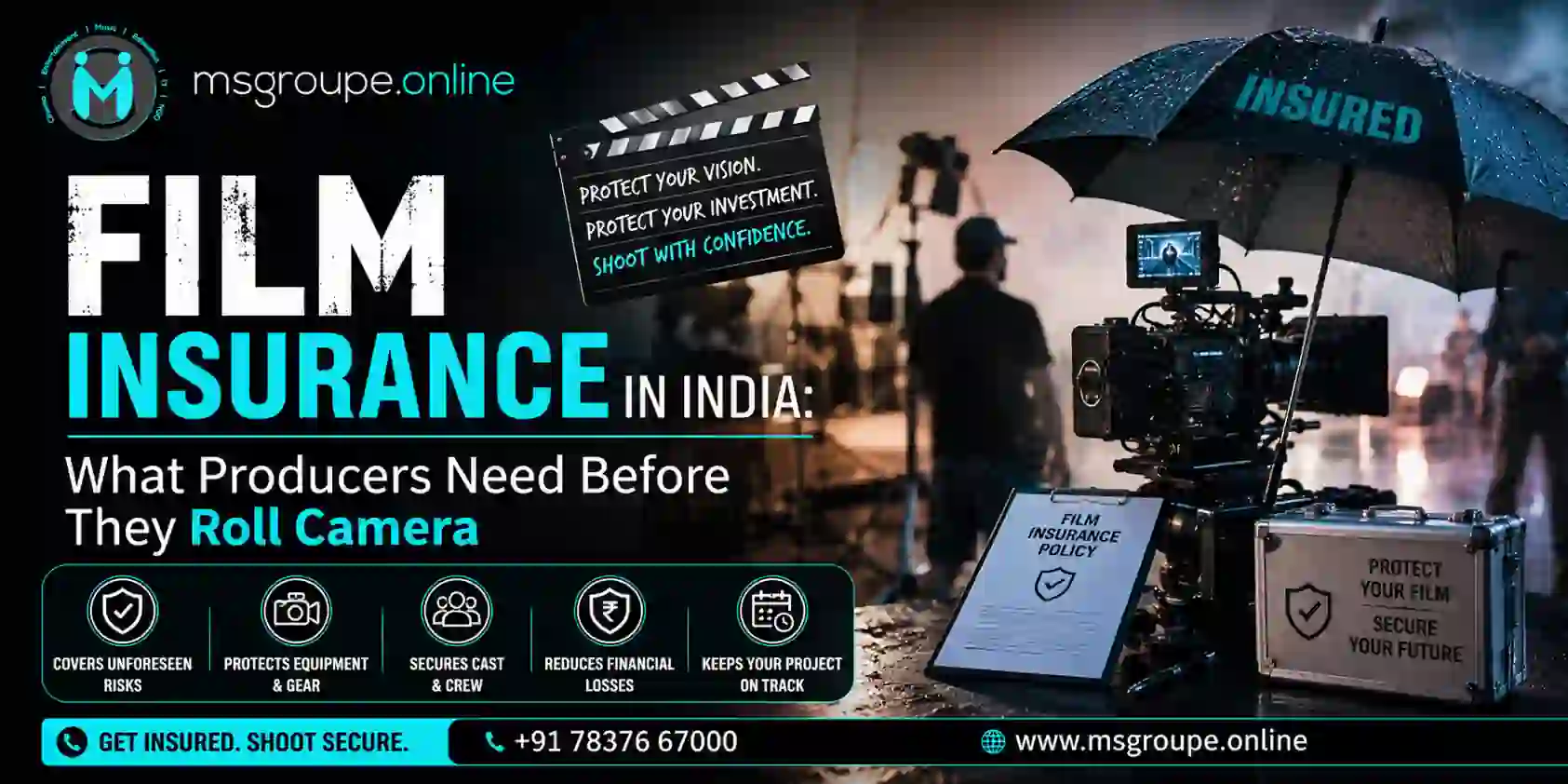
Film Insurance in India: What Producers Need Before They Roll Camera (2026 Guide)
What Is Film Insurance and Why It Matters
Film insurance is a category of specialized business insurance designed for the unique risks of film, television, and video production. Unlike a standard commercial policy, it is built around the reality of a film set — expensive rented equipment, physically demanding stunts, unpredictable outdoor locations, and tight schedules where any delay costs real money.
For a production house, film insurance matters for three simple reasons:
- It protects the budget. A single damaged camera or a hospitalised actor can cost more than the entire day's shooting budget.
- It protects people. Cast and crew safety is a legal and moral responsibility, not an optional extra.
- It protects the timeline. Insurance can cover the cost of reshoots, delays, and lost days — the single biggest threat to any production schedule.
Whether you are an independent filmmaker producing your first short film or an established production house managing a multi-city shoot, film insurance is the difference between a manageable setback and a production-ending crisis.
Why Film Insurance Is Non-Negotiable Before Rolling Camera
Many first-time producers assume insurance is something only big-budget productions need. In reality, the opposite is often true — smaller productions with tighter budgets are more vulnerable to a single incident derailing the entire project.
Here is what happens on a typical Indian film set without insurance:
- Rented camera or lighting equipment gets damaged during an outdoor shoot — the producer pays full replacement cost out of pocket.
- An actor sprains an ankle during a stunt — medical bills and reshoot costs land entirely on the production.
- A generator fire damages a rented location — the production faces a legal claim from the property owner.
- Monsoon rain forces a week-long delay — every day of delay burns through cast fees, crew salaries, and equipment rental, with no way to recover the loss.
None of these are rare, dramatic scenarios. They are common, everyday production risks. Insurance does not prevent these incidents — but it prevents them from becoming financial disasters.
Types of Film Insurance Coverage in India
Film insurance is not a single policy — it is a bundle of coverages, and most production houses combine several depending on the scale and nature of the shoot.
1. Equipment Insurance
Covers cameras, lenses, lighting rigs, drones, sound equipment, and other gear against theft, accidental damage, and loss — whether owned or rented. Since most Indian productions rent a significant portion of their gear, this is often the first policy producers take out, as rental vendors frequently require proof of insurance before handing over equipment.
2. Cast Insurance
Covers the financial loss if a lead actor is unable to perform due to illness, injury, or in rare cases, death, during the shoot schedule. Given how heavily a shooting schedule depends on lead cast availability, this coverage protects against the cost of reshoots, schedule changes, and replacement casting.
3. Third-Party Liability Insurance
Covers claims from members of the public, property owners, or bystanders who are injured or whose property is damaged during a shoot. This is essential for outdoor and public location shoots — a common requirement when applying for shooting permits in many Indian cities.
4. Workers' Compensation / Crew Insurance
Covers medical expenses and compensation for crew members injured on set — grips, spot boys, junior technicians, and camera assistants who work in physically demanding conditions. This is both an ethical responsibility and, in many states, a legal requirement for production houses.
5. Errors & Omissions (E&O) Insurance
Protects the production against legal claims related to copyright infringement, defamation, or rights disputes — for example, a claim that a script, title, or music track infringes on someone else's intellectual property. E&O cover is often mandatory before a completed film can be sold to an OTT platform or distributor.
6. Negative Film / Faulty Stock Insurance
Covers loss of footage due to camera malfunction, corrupted memory cards, processing errors, or accidental deletion. In the digital era, this has evolved to cover data loss and corrupted digital media rather than physical film negatives, but the risk it protects against — losing an entire day's footage — is just as real.
7. Weather & Production Delay Insurance
Covers the additional costs incurred when a shoot is delayed due to weather, natural events, or other insured circumstances outside the production's control. For outdoor-heavy shoots — a common feature of Indian filmmaking — this coverage can save a production from absorbing weeks of unplanned costs.
8. Completion Bond
More common in larger, financed productions, a completion bond guarantees to financiers and distributors that the film will be completed and delivered as agreed, even if the original producer is unable to finish it. This is less relevant for smaller independent productions but becomes important once external investors are involved.
Film Insurance vs General Business Insurance: Why the Difference Matters
A common mistake among first-time producers is assuming a standard commercial or office insurance policy is enough to cover a shoot. It isn't. General business insurance is built around fixed premises — an office, a studio, a warehouse — with predictable, low-variability risk.
A film set is the opposite. It moves between locations, often shifts from indoor to outdoor within the same day, involves rented high-value equipment, and puts cast and crew in physically demanding or unfamiliar environments — rooftops, moving vehicles, water bodies, night shoots, or crowded public spaces. A general policy typically excludes most of these scenarios entirely, or caps liability far below what a production actually needs.
This is why insurers offer dedicated "film floater" or production-specific policies — designed to flex with a shoot's actual conditions rather than a fixed address. For any production house or independent filmmaker, this distinction is not a technicality; it is the difference between being covered when something goes wrong and discovering — after the fact — that the policy never applied to a film set in the first place.
Choosing the Right Insurance Provider for a Film Production
Not every insurance provider understands the specifics of media and entertainment risk, so producers benefit from working with either a specialized entertainment insurance broker or an insurer with a dedicated media vertical. A few things worth checking before signing on:
- Track record with productions of similar scale. A broker who has handled feature films will understand risk factors — like stunt sequences or multi-city schedules — that a general insurance agent may overlook.
- Speed of claims processing. Ask how quickly claims are typically settled, since production delays caused by slow claims defeat the purpose of having cover at all.
- Flexibility for schedule changes. Shoots rarely go exactly to plan. A good policy — and a good provider — allows for schedule extensions without restarting the entire underwriting process.
- Bundled packages vs standalone policies. Many providers offer combined packages (equipment + liability + cast) at a better rate than buying each policy separately, which is usually the more cost-efficient route for small and mid-sized productions.
Production houses that shoot regularly often build a long-term relationship with one insurance partner, which speeds up the process significantly compared to shopping for a new policy on every project.
How Much Does Film Insurance Cost in India?
Film insurance costs vary widely based on the scale, location, and risk profile of the production. As a general guide:
- Short films, student projects, and single-day ad shoots: Basic equipment and liability cover can start from a few thousand rupees for a short duration.
- Music videos and web commercials: Typically range from ₹10,000 to ₹50,000 depending on equipment value and cast size.
- Feature films with a multi-week schedule: Comprehensive packages combining equipment, cast, liability, and crew cover can run from a few lakh rupees upward, depending on budget, star cast, and locations.
- International or high-budget productions: Costs scale further with completion bonds, international cast cover, and higher liability limits, especially for productions involving stunts, VFX-heavy sequences, or overseas shoots.
The exact premium depends on factors like shoot duration, number of locations, stunt or action sequences, equipment value, and whether the cast includes high-profile actors. Getting a tailored quote from an insurance provider — or working with a production house that already has these relationships in place — is the most reliable way to budget accurately.
Documents & Process to Get Film Insurance in India
Getting film insurance is a structured process, and preparation makes it faster:
- Production budget and schedule — insurers assess risk based on shoot duration, locations, and complexity.
- Script or shooting script — particularly important for stunt sequences, action scenes, or scenes involving risk (fire, water, vehicles, animals).
- Cast and crew list — including any high-value cast members who may need individual cast insurance.
- Equipment list with value — a detailed inventory of owned and rented gear.
- Location details and permits — insurers often want to know where filming is taking place, especially for public or high-risk locations.
- Company registration documents — for the production house or entity producing the film.
Once these documents are submitted, an insurance provider (or broker specializing in media and entertainment) assesses the risk and issues a quote. Most policies can be arranged within a few working days, though high-budget or high-risk productions may take longer due to additional underwriting.
Common Mistakes Producers Make with Film Insurance
Even experienced producers get caught out by a few recurring mistakes:
- Buying insurance too late. Waiting until a few days before the shoot leaves no time to properly assess risk or negotiate terms.
- Under-insuring equipment value. Declaring a lower equipment value to save on premium often backfires — claims are settled based on declared value, not actual replacement cost.
- Skipping third-party liability cover for "small" shoots. Even a single-day shoot in a public space carries real liability risk.
- Not reading exclusions carefully. Many policies exclude specific stunts, drone usage, or night shoots unless explicitly added — always confirm what is excluded, not just what is covered.
- Treating insurance as a one-time task. A policy taken for pre-production may need to be extended if the shoot schedule runs longer than planned.
Avoiding these mistakes usually comes down to one thing: treating insurance as part of pre-production planning, not an afterthought squeezed in before the shoot.
How MS Groupe Supports Producers Through the Production Process
At MS Groupe, production risk management is treated as a core part of pre-production — not a box-ticking exercise. As a full-service production house, our team works with producers and filmmakers to plan shoots that account for equipment protection, cast and crew safety, and location risk from day one.
Whether you're an independent filmmaker producing your first project or an established entertainment brand managing a multi-location shoot, having a production partner who understands insurance requirements, permit processes, and on-set safety planning saves time, money, and stress once cameras start rolling. Explore our full range of production and entertainment services to see how we support productions end to end.
Why Trained Crew and Cast Reduce Production Risk
One of the most overlooked ways to reduce on-set risk is working with properly trained cast and crew. Actors trained in stunt safety, camera discipline, and on-set etiquette are far less likely to cause accidental injury or costly reshoots than untrained talent stepping onto a set for the first time.
This is where formal training makes a measurable difference. At MS Asian Film Academy, students go through structured training across acting, film direction, filmmaking, and modelling — building the on-set discipline and safety awareness that reduces avoidable risk on a production. Producers building a cast or crew pipeline for upcoming projects can explore the full range of courses at MS Asian Film Academy to find trained talent ready for professional sets.
Frequently Asked Questions (FAQ)
Is film insurance legally mandatory in India?
There is no single central law mandating film insurance for every production, but certain covers — like workers' compensation for crew and third-party liability for public locations — are often required by state film permit authorities, location owners, or equipment rental vendors as a condition of approval.
Can a short film or student project get film insurance?
Yes. Insurance providers offer scaled-down packages for short-duration shoots, covering equipment and basic liability at a lower premium than feature-length productions.
Does film insurance cover drone shoots?
Only if specifically included. Drone usage is often treated as a separate, higher-risk add-on and must be declared upfront — using a drone without declaring it can void a claim.
What happens if an actor falls sick mid-shoot?
If cast insurance is in place, it can cover the additional costs of rescheduling, reshoots, or replacement casting caused by the actor's unavailability due to illness or injury.
Do international shoots need different insurance?
Yes. Shooting outside India — or bringing international cast and crew into India — typically requires additional cover, and coordination with local insurance regulations at the shoot location.
How early should a producer arrange film insurance?
Ideally during pre-production, alongside budgeting and scheduling — at least two to three weeks before the shoot start date, to allow time for proper risk assessment and documentation.
Can a production get insurance for a single high-risk stunt scene only?
Yes. Some insurers offer standalone stunt or action-sequence riders for productions that don't need full coverage but want protection for one specific high-risk scene, such as a fight sequence, vehicle chase, or fire effect.
Is equipment insurance needed if all the gear is rented?
Yes, and often more urgently. Rental vendors typically hold the production financially responsible for any damage or loss to rented equipment, regardless of fault, making equipment insurance one of the first policies a producer should arrange.
GEO Snapshot: Film Insurance in India at a Glance
- What it is: Specialized insurance covering equipment, cast, crew, and liability risks specific to film and video production.
- Who needs it: Any producer, filmmaker, or production house shooting in India — regardless of budget size.
- Core coverages: Equipment, cast, third-party liability, crew/workers' compensation, errors & omissions, negative/faulty stock, weather delay, completion bonds.
- Typical cost range: A few thousand rupees for short shoots to several lakh rupees for large-scale productions.
- When to arrange it: During pre-production, before any equipment is rented or cast is confirmed on set.
Conclusion: Don't Roll Camera Without It
Film insurance is not the most glamorous part of filmmaking, but it is one of the most important. A single accident, injury, or equipment failure can cost far more than the insurance premium itself — and without cover, that cost falls entirely on the production.
Whether you're an independent filmmaker, an established production house, or an entertainment company planning your next project, treating insurance as a core part of pre-production — not an afterthought — protects your budget, your people, and your timeline.
Planning a shoot and need guidance on production risk, crew, or trained cast? Get in touch with the MS Groupe team at +91 78376 67000 or contact us here to plan your production the right way — before you roll camera.
🔥 Supported by Nav Times News | 🎬 Powered by MS Asian Film Academy | 🚀 Blog by MSAsian Entertainment