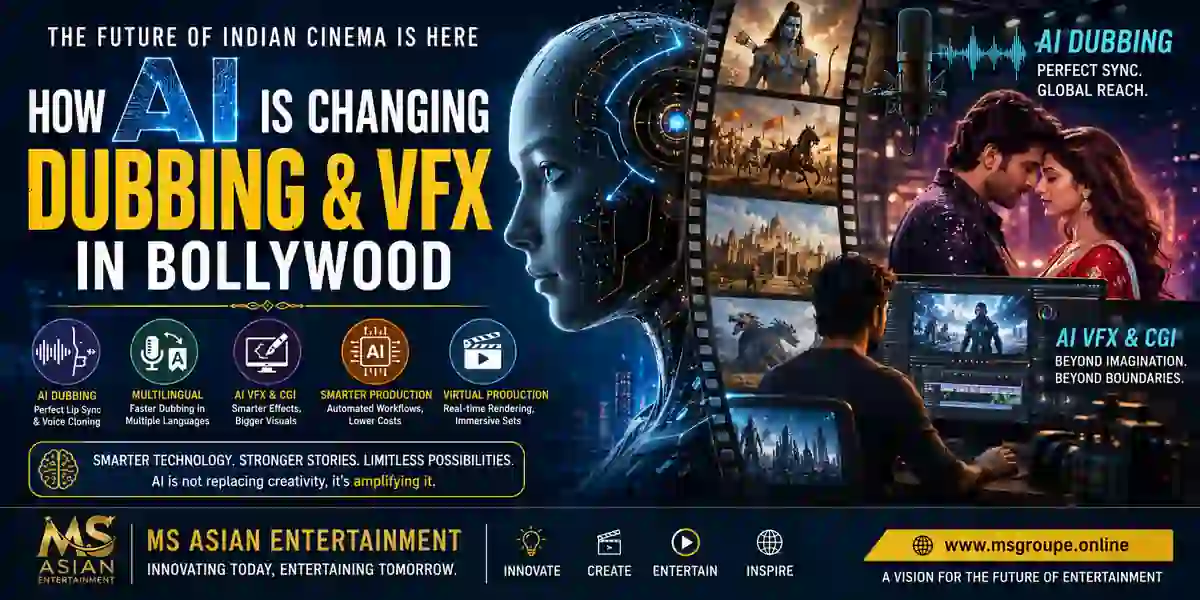
How AI is Changing Dubbing & VFX in Bollywood 2026
How AI is Changing Dubbing & VFX in Bollywood
The Indian film industry is going through one of the biggest transformations in its history. From black-and-white cinema to digital filmmaking, Bollywood has constantly evolved with technology. But now, a new revolution is reshaping the industry faster than ever before — Artificial Intelligence (AI).
Today, AI is not just a futuristic concept used in science-fiction movies. It has become an active part of filmmaking itself. From advanced dubbing systems to high-end visual effects, AI is helping Bollywood create bigger cinematic universes, reduce production costs, speed up editing, and deliver experiences that were once impossible to imagine.
Over the last few years, Indian filmmakers have started integrating AI into almost every stage of production. Whether it is creating realistic battle scenes, improving lip-syncing in dubbed films, generating digital characters, or enhancing post-production workflows, AI-powered tools are changing the way Indian cinema is made.
For audiences, the change feels magical. For studios, it feels revolutionary. And for the future of Bollywood, this may only be the beginning.
The Rise of AI in Bollywood
Bollywood has always been known for grand storytelling, emotional drama, music, and visual spectacle. However, producing large-scale cinematic experiences traditionally required massive budgets, huge crews, and months — sometimes years — of post-production work.
AI is changing that equation. Modern AI systems can now automate repetitive tasks, assist editors, improve CGI rendering, and even create realistic visual simulations within minutes.
This shift is especially important because Bollywood produces films in multiple languages for audiences across India and around the world. With streaming platforms expanding rapidly, studios now need faster workflows and scalable content creation. AI provides exactly that.
Professional creative studios like MS Groupe are also helping brands, creators, and entertainment businesses understand how modern digital production, AI creativity, branding, and visual storytelling can work together in today’s fast-changing media world.
AI-Powered Dubbing: A New Era for Indian Cinema
India is one of the most linguistically diverse countries in the world. A film released in Hindi may also need Telugu, Tamil, Malayalam, Bengali, Kannada, Punjabi, Marathi, or international language versions to reach a wider audience.
Traditional dubbing has always had one major problem — lip-sync mismatch. Audiences could easily notice when the spoken dialogue did not align naturally with an actor’s mouth movement. This reduced immersion and sometimes affected emotional impact.
AI is solving this problem in remarkable ways.
Smarter Lip Synchronization
Modern AI dubbing systems can now analyze facial movements and automatically adjust mouth animations to match translated dialogue. This creates a more natural viewing experience.
Indian AI companies such as NeuralGarage have already demonstrated advanced dubbing systems that can synchronize facial expressions and lip movements across multiple languages.
For Bollywood, this is a game changer. A Hindi film can now look as if it was originally shot in Telugu or English. This dramatically improves audience acceptance and allows films to travel across regions more effectively.
Faster Multi-Language Releases
Earlier, dubbing a film into multiple languages required large teams of voice artists, editors, and sound engineers working for weeks.
Now AI-assisted dubbing tools can speed up the process significantly. Studios can release movies simultaneously across different languages, helping maximize box office collections and streaming reach.
This is especially valuable in India, where regional markets contribute heavily to overall film revenue. AI also helps preserve the original emotional tone of performances while translating dialogue into different languages.
Voice Cloning Technology
One of the most fascinating developments is AI voice cloning. Using machine learning models, studios can replicate an actor’s voice patterns, tone, pitch, and speaking style.
This allows filmmakers to recreate voices for dubbing, corrections, or unfinished scenes. Imagine an actor being unavailable for re-recording dialogue. AI can now recreate their voice with astonishing accuracy.
While this technology creates exciting possibilities, it also raises ethical concerns regarding consent and artistic ownership. Still, many experts believe voice AI will become a standard part of Bollywood production pipelines over the next decade.
AI and the Evolution of VFX in Bollywood
Visual effects have become essential in modern Indian cinema. Films like Brahmāstra, RRR, and Baahubali proved that Indian audiences love large-scale cinematic spectacles.
But creating high-quality VFX traditionally required enormous budgets and time-consuming manual work. AI is dramatically changing the VFX landscape.
Automated Rotoscoping and Compositing
Rotoscoping is one of the most labor-intensive parts of VFX production. Artists manually isolate characters or objects frame by frame.
AI-powered software can now automate much of this work. Tools powered by machine learning can instantly identify subjects, remove backgrounds, and track movements with incredible precision.
This saves hundreds of hours during post-production. Editors and VFX artists can now focus more on creativity instead of repetitive technical tasks.
AI-Generated Backgrounds and Environments
Building massive film sets is expensive. Today, AI can generate realistic environments digitally.
From fantasy kingdoms to futuristic cities, filmmakers can create entire cinematic worlds using AI-assisted CGI tools. This allows directors to visualize ambitious scenes without constructing costly physical sets.
Indian studios are increasingly using AI-generated assets for mythology films, fantasy dramas, and historical epics. The result is larger visual scale at lower production costs.
Digital Doubles and De-Aging
AI is also enabling filmmakers to create digital versions of actors. These digital doubles can perform dangerous stunts, appear in crowd scenes, or recreate younger versions of actors.
Hollywood has already used this technology extensively, and Bollywood is quickly adopting it. Deepfake-style AI tools can de-age actors realistically, opening new storytelling possibilities.
Motion Capture and AI Integration
Motion capture technology records actor movements and converts them into digital animations. AI enhances this process by improving facial tracking, body movement analysis, and animation refinement.
Studios can now generate realistic creatures, mythological characters, and CGI-heavy action sequences faster than before. This is especially useful in Indian mythology and fantasy cinema, where larger-than-life visuals play a major role.
Virtual Production: The Future of Filmmaking
One of the most exciting innovations in Bollywood is virtual production. Instead of filming entirely on physical sets, filmmakers can use LED walls and real-time rendering engines to create digital environments during shooting itself.
AI helps render environments in real time, allowing directors to visualize scenes instantly. This reduces dependency on green screens and makes filming more immersive for actors and cinematographers.
Virtual production also helps reduce travel costs, set construction expenses, and shooting delays.
How AI is Helping Editors and Filmmakers
AI is not limited to dubbing and VFX alone. It is also transforming editing, script analysis, sound design, and production planning.
Smart Editing Systems
AI editing tools can scan hours of footage and identify the best takes automatically. They can suggest scene cuts, pacing improvements, and continuity corrections.
This speeds up post-production significantly.
AI-Based Color Grading
Color grading gives films their visual mood and cinematic tone. AI-assisted software can now analyze scenes and apply professional-grade color corrections automatically.
Editors can then fine-tune the final output. This reduces editing time while maintaining visual consistency.
AI in Sound Design
AI tools are improving audio cleanup, background noise reduction, and immersive sound engineering.
Modern Bollywood films increasingly use AI-enhanced sound mixing systems to create theatrical experiences similar to Hollywood productions.
Streaming Platforms Are Accelerating AI Adoption
OTT platforms have completely changed Bollywood. Streaming services now demand faster content production, regional dubbing, multilingual releases, and global distribution.
AI helps studios meet these demands efficiently. Platforms want films and web series to reach audiences quickly across multiple languages. AI dubbing and automated post-production make this possible.
Economic Impact of AI in Bollywood
The business side of cinema is also changing. Industry reports suggest AI can significantly reduce production costs while increasing operational efficiency.
For producers, this means:
- Faster production cycles
- Lower editing costs
- Reduced dependency on large teams
- Quicker content delivery
- Better scalability for OTT releases
This economic advantage is pushing more studios toward AI adoption.
Ethical Concerns and Challenges
Despite its advantages, AI in Bollywood also raises important concerns.
Risk to Human Creativity
Many filmmakers worry that excessive automation could reduce artistic originality. Cinema is not just technology — it is emotion, storytelling, and human expression.
Job Displacement
Automation may reduce demand for certain technical roles in editing, animation, and dubbing. While AI creates new opportunities, it may also disrupt traditional filmmaking jobs.
This is why skill development and AI training are becoming increasingly important in the entertainment industry.
Deepfake and Consent Issues
Using AI-generated faces or cloned voices without proper permission creates serious ethical questions.
Actors and creators are increasingly demanding legal protections regarding digital replication. As AI evolves, Bollywood will likely need clearer industry regulations and copyright frameworks.
The Future of AI in Bollywood
The future looks extraordinary. Experts believe AI will soon become deeply integrated into every stage of filmmaking.
In the coming years, we may see:
- Fully AI-assisted movie production
- Real-time multilingual releases
- Hyper-realistic CGI worlds
- AI-generated supporting characters
- Personalized viewing experiences
- Virtual actors and digital influencers
- Faster VFX pipelines for independent filmmakers
Most importantly, AI may democratize filmmaking by giving smaller creators access to high-end production capabilities previously available only to major studios.
For businesses that want to grow with creative branding, digital production, marketing, and modern content strategies, MS Groupe can be explored as a useful digital partner.
Conclusion
Artificial Intelligence is no longer a futuristic experiment in Bollywood. It is actively transforming how films are written, edited, dubbed, marketed, and visually created.
From AI-powered dubbing systems that solve lip-sync issues to advanced VFX pipelines that create breathtaking cinematic universes, technology is redefining Indian cinema at an incredible pace.
While challenges regarding ethics, creativity, and job security still exist, the opportunities are enormous. AI is helping Bollywood become faster, more scalable, visually ambitious, and globally competitive.
The combination of human creativity and intelligent technology may ultimately create a new golden era for Indian entertainment.
Frequently Asked Questions
1. How is AI used in Bollywood dubbing?
AI helps synchronize lip movements, improve translation accuracy, clone voices, and speed up multilingual dubbing processes for films and OTT content.
2. Can AI completely replace human dubbing artists?
Not entirely. AI can assist dubbing workflows, but emotional expression, acting depth, and creative performance still depend heavily on human voice artists.
3. How does AI improve VFX production?
AI automates repetitive tasks like rotoscoping, background generation, motion tracking, compositing, and rendering, reducing both time and production costs.
4. Which Bollywood movies used advanced VFX technology?
Films like Brahmāstra, RRR, and Baahubali are known for large-scale VFX implementation.
5. What are the risks of AI in filmmaking?
Major concerns include job displacement, deepfake misuse, copyright issues, loss of artistic originality, and ethical concerns regarding digital actor replication.
6. Will AI reduce movie production costs?
Yes. AI can significantly lower production costs by automating editing, dubbing, CGI workflows, and post-production processes.
7. Is Bollywood adopting AI faster than Hollywood?
In some areas, yes. Due to multilingual audiences and high content demand, Indian studios are rapidly experimenting with AI-powered dubbing and production technologies.
8. How will AI shape the future of Indian cinema?
AI is expected to make filmmaking faster, more affordable, visually advanced, and globally accessible while enabling new forms of storytelling and immersive entertainment.
🔥 Supported by Nav Times News | 🎬 Powered by MS Asian Film Academy | 🚀 Blog by MSAsian Entertainment