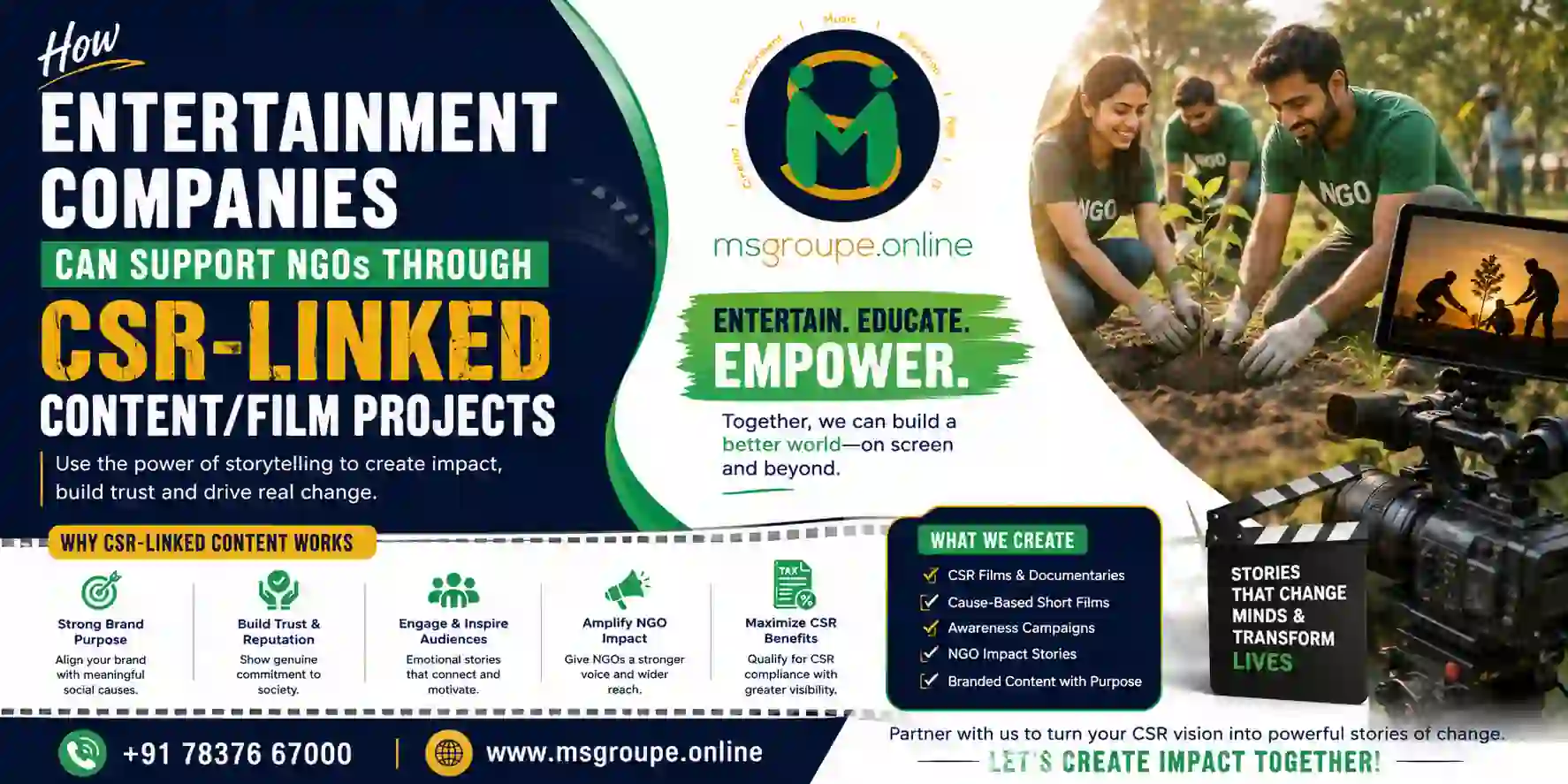
How Entertainment Companies Support NGOs Through CSR Film Projects
Why Entertainment Companies Are a Natural Fit for CSR
NGOs are experts in grassroots impact — healthcare camps, literacy drives, environmental restoration, rehabilitation programs. What most NGOs lack is the storytelling infrastructure to communicate that impact at scale. This is precisely where an experienced entertainment company adds value.
A production house brings three things an NGO rarely has in-house:
- Cinematic storytelling capability — turning field data and testimonials into emotionally resonant narratives
- Distribution reach — access to OTT platforms, film festivals, social media audiences, and press networks
- Production discipline — budgeting, scheduling, permissions, and post-production workflows that meet broadcast-quality standards
When these strengths combine with an NGO’s on-ground credibility, the result is content that doesn’t just inform — it moves people to donate, volunteer, or change behaviour.
Common CSR-Linked Content and Film Formats
Not every NGO partnership needs a feature film. In fact, most successful CSR collaborations use a mix of formats depending on budget, timeline, and campaign goals.
1. Documentary Films and Short Docs
A well-produced documentary remains the gold standard for CSR storytelling. A 20–40 minute short documentary can follow a single beneficiary’s journey — a girl completing her education through an NGO scholarship, a farmer adopting sustainable irrigation, or a community rebuilding after a natural disaster. These films often go on to screen at film festivals, giving both the NGO and the sponsoring brand additional visibility and credibility.
2. Ad Films and Brand Campaign Films
Many companies fund CSR ad films that blend brand messaging with the NGO’s cause. These are shorter (60 seconds to 5 minutes), built for television and digital advertising, and designed to drive immediate action — a donation link, a hashtag campaign, or app downloads.
3. Web Series and Digital Docu-Series
For causes that unfold over months or years — such as a rural healthcare initiative or a skill-development program — a multi-episode digital series allows the story to breathe. Each episode can highlight a different beneficiary or milestone, keeping audiences engaged over a longer CSR cycle.
4. Corporate Video and Impact Reports
Beyond public-facing content, many companies now commission corporate video productions that double as CSR impact reports for stakeholders, investors, and internal teams. These are polished, data-backed films that translate CSR spending into visible, measurable outcomes.
5. Music and Sound-Led Campaigns
Sound design and original music play a bigger role in CSR content than most brands realise. A powerful score or an original track composed for a cause campaign can extend a film’s emotional reach and give it a shareable, standalone identity on music platforms.
How the Partnership Actually Works: A Step-by-Step Structure
For entertainment companies exploring their first CSR collaboration, here is a practical structure that works across most NGO partnerships.
Step 1: Cause Alignment and Discovery
The production house and NGO sit down to identify a cause that aligns with both the NGO’s mission and the sponsoring brand’s CSR budget allocation (education, health, environment, gender equity, etc.). This stage typically includes site visits, beneficiary interviews, and a review of the NGO’s existing data and success metrics.
Step 2: Concept and Script Development
Once the cause is defined, the creative team develops a concept note and script. Unlike commercial films, CSR content must balance emotional storytelling with factual accuracy — every claim about impact needs to be verifiable, since these films are often scrutinised by CSR compliance teams and auditors under India’s Companies Act CSR provisions.
Step 3: Production Planning and Location Scouting
Location scouting for NGO projects often means working in real communities rather than controlled sets — villages, schools, hospitals, or relief camps. This requires sensitivity, proper permissions, and a production team experienced in documentary-style, low-disruption filming.
Step 4: Filming and Direction
Directors working on CSR content need a different skill set than commercial filmmakers — patience, trust-building with subjects, and the ability to capture authentic, unscripted moments. A trained filmmaker who understands both narrative craft and ethical documentary practice is essential here.
Step 5: Post-Production and Colour Grading
Post-production, including editing, sound design, and colour grading, shapes the final emotional tone. CSR films often use warmer, more naturalistic colour grading than commercial ads, to preserve authenticity rather than glamourise the subject matter.
Step 6: Distribution and Impact Measurement
The final and most overlooked step is distribution strategy. A brilliant film with no distribution plan achieves little. This includes film festival submissions, OTT placement, social media rollout, influencer amplification, and press outreach — each measured against clear KPIs like views, donations generated, or volunteer sign-ups.
Benefits for the Entertainment Company
CSR-linked film projects aren’t just charitable work for a production house — they are strategic business decisions.
- Portfolio diversification: Documentary and social-impact credits strengthen a studio’s festival reputation and open doors to grant-funded and international co-production opportunities.
- Talent development: CSR projects are excellent training ground for emerging directors, editors, and sound engineers to build real-world credits.
- Brand partnerships: Corporates actively look for production houses with a demonstrated CSR portfolio when awarding larger commercial contracts.
- Award and festival recognition: Impact-driven films frequently perform well at festivals with dedicated social-cause categories, generating press coverage that money can’t buy.
Benefits for the NGO
- Professional storytelling that dramatically increases donor engagement compared to amateur-shot content
- Wider distribution through the production house’s existing network of platforms, festivals, and media contacts
- Credibility that comes from association with an established entertainment company or production house
- Reusable content assets — a single well-produced film can be repurposed into social clips, donor pitch decks, and annual report material for years
Choosing the Right Production Partner
Not every production house is built for CSR work. NGOs and CSR heads should evaluate potential partners on:
- Documentary and non-fiction experience, not just commercial ad work
- Ethical filming practices around consent, child protection, and community sensitivity
- Transparent budgeting, since CSR funds are subject to strict compliance and audit trails
- A trained crew — including directors, cinematographers, and editors who understand both craft and cause-driven storytelling
- Post-production capability in-house, avoiding costly and time-consuming external vendor handoffs
This is where a full-spectrum entertainment company with an in-house acting school, direction training, and production wing has a distinct advantage — the same talent pipeline trained for commercial film and OTT work is equally equipped to handle CSR storytelling with craft and sensitivity.
The Role of Trained Talent in CSR Storytelling
CSR films often blend documentary footage with dramatised or reconstructed sequences — a doctor’s discovery scene, a family’s turning point, a mentor-student moment. These reconstructed scenes need actors capable of subtle, believable performances rather than theatrical delivery.
This is where institutions like MS Asian Film Academy play a critical role. Actors trained in method acting and naturalistic performance techniques can seamlessly blend into real community settings without breaking the authenticity that CSR audiences expect. If you’re a filmmaker or CSR agency looking for performers trained specifically for this kind of nuanced, realism-driven work, explore the acting course and broader course offerings at MS Asian Film Academy.
For teams building the next generation of socially conscious filmmakers, structured training in direction and production also matters. Aspiring directors can build these skills through the film direction course and filmmaking course, while campaigns needing on-camera talent for public service messaging can draw from students trained through the modelling course.
Measuring the Real Impact of CSR Film Projects
CSR spending increasingly demands measurable ROI, even for creative projects. Entertainment companies working with NGOs should build measurement frameworks around:
- Reach metrics: views, shares, festival selections, press mentions
- Action metrics: donations, volunteer sign-ups, petition signatures directly attributed to the campaign
- Sentiment metrics: audience comments, survey feedback, and brand perception shifts
- Longevity metrics: how long the content continues generating engagement post-launch
A production house that can present this data back to CSR committees — rather than just delivering a finished film — becomes a long-term partner rather than a one-time vendor.
Common Mistakes to Avoid
- Over-glamourising the cause: Excessive dramatisation can undermine credibility and come across as exploitative rather than empathetic.
- Ignoring compliance requirements: CSR content tied to Indian corporate CSR budgets must align with Schedule VII of the Companies Act, and production houses should be familiar with these guardrails.
- Skipping consent protocols: Every beneficiary, especially minors, must have documented, informed consent before filming and distribution.
- Underinvesting in distribution: Many CSR films are shelved after a single screening. A distribution budget should be planned from day one, not as an afterthought.
- Choosing vendors purely on cost: The cheapest production quote often results in weak storytelling that fails to move audiences or funders.
Why Partner With Msasian Entertainment (MS Groupe)
As a multi-vertical entertainment company, MS Groupe brings together production, direction, and trained acting talent under one roof — making us uniquely positioned for CSR-linked film projects that need both technical polish and human authenticity. Our verticals span production, filmmaker services, and talent development, giving NGOs and corporates a single accountable partner from concept to distribution.
Explore our full range of offerings on the services page, or learn more about our journey and team on the about us page.
If your organisation is planning a CSR-linked documentary, ad film, or digital campaign with an NGO partner, our team can guide you from concept development to final distribution.
Call us at +91 7837667000 or visit our contact page to start a conversation about your CSR film project today.
Frequently Asked Questions
Q1. What is CSR-linked content in the entertainment industry?
CSR-linked content refers to films, documentaries, or digital campaigns produced by an entertainment company in partnership with an NGO or corporate CSR division, aimed at raising awareness and driving measurable social impact around a specific cause.
Q2. How do entertainment companies benefit from NGO partnerships?
Entertainment companies gain portfolio diversification, festival recognition, talent development opportunities, and stronger brand partnerships by demonstrating a track record of purposeful, cause-driven filmmaking.
Q3. What type of film works best for CSR campaigns?
Short documentaries (20–40 minutes) are the most common and effective format, though ad films, web series, and corporate video impact reports are also widely used depending on the campaign’s goals and timeline.
Q4. Do actors need special training for CSR and documentary-style films?
Yes. CSR films often require naturalistic, subtle performances that blend with real community footage, which is why training in method acting and camera presence, such as that offered at MS Asian Film Academy, is highly valuable.
Q5. How is the success of a CSR film measured?
Success is measured through reach metrics (views, festival selections), action metrics (donations, volunteer sign-ups), sentiment metrics (audience feedback), and longevity metrics (sustained engagement post-launch).
Q6. How can our company start a CSR film project with MS Groupe?
You can reach out through our contact page or call +91 7837667000 to discuss your cause, budget, and timeline with our production team.
Msasian Entertainment operates through MS Groupe (production house, filmmaker services, and entertainment company) and MS Asian Film Academy (acting school), offering end-to-end support for CSR-linked content and film projects across India.
🔥 Supported by Nav Times News | 🎬 Powered by MS Asian Film Academy | 🚀 Blog by MSAsian Entertainment