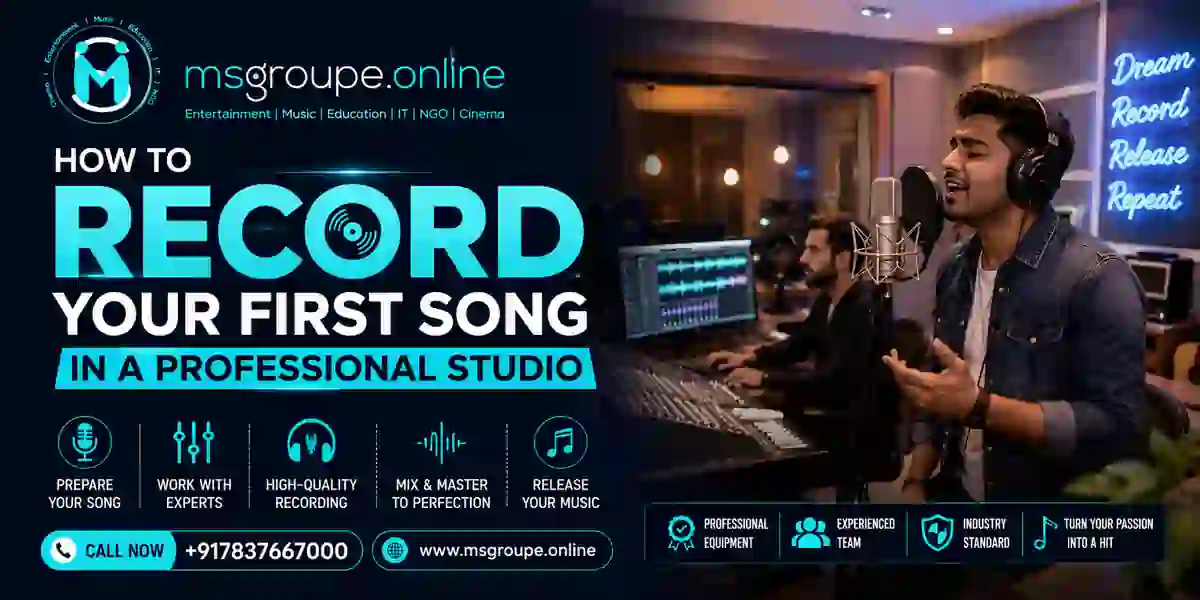
How to Record Your First Song in a Professional Studio (2026 Beginner's Guide)
Why Recording in a Professional Studio Matters
Home recording setups have improved a lot, but they still can't match the acoustic treatment, high-end microphones, analog gear, and trained ears you get in a professional studio. A good studio doesn't just capture sound — it shapes it.
Here's what a professional studio environment gives you that a bedroom setup usually can't:
- Acoustically treated rooms that eliminate unwanted echo and reflection
- Industry-grade microphones and preamps that capture vocal nuance and instrument detail
- Experienced sound engineers and producers who understand arrangement, tone, and performance
- Professional mixing and mastering tools for a release-ready final product
- Creative direction from people who work with artists, filmmakers, and entertainment brands every day
If you're serious about your music career, recording your first song in a professional setup — rather than a makeshift home studio — gives your track the polish it needs to compete in today's streaming-driven industry.
Step 1: Prepare Before You Ever Step Into the Studio
Professional studio time is valuable, and most facilities charge by the hour. The single biggest mistake beginners make is showing up unprepared and "figuring it out" in the booth. Preparation is where 80% of a great recording actually happens.
Finish Writing and Structuring Your Song
Before you book a session, your song should be complete — verses, chorus, bridge, and any ad-libs should be written and finalized. Decide on the structure (for example: intro–verse–chorus–verse–chorus–bridge–chorus–outro) so the engineer can map out your session efficiently.
Rehearse Until It Feels Natural
Practice your song daily in the weeks leading up to your session. Record yourself on your phone and listen back critically. Ask yourself:
- Am I hitting every note consistently?
- Is my breathing controlled?
- Does my delivery match the emotion of the lyrics?
The more comfortable you are with the song outside the studio, the more confident and expressive your performance will be inside it.
Work on Your Stage Presence and Performance Confidence
A song is a performance, not just a sequence of correct notes. Many first-time artists sing technically well but sound flat or nervous because they haven't trained their performance instincts. This is exactly where formal training helps — vocalists, actors, and performers who go through structured coaching tend to deliver more confident, emotionally resonant takes.
If you want to build genuine performance confidence before your recording session, training programs like those offered by the MS Asian Film Academy help artists develop stage presence, breath control, and emotional expression — skills that translate directly into stronger vocal takes.
Choose Your Key and Tempo in Advance
Work with a producer or musician beforehand to lock in the right key for your vocal range and the correct BPM (beats per minute) for the mood of the song. Changing these mid-session wastes time and can throw off your performance.
Step 2: Choose the Right Professional Studio and Production House
Not every studio is the right fit for every artist. Before booking, consider:
- Genre specialization — Some studios are built for hip-hop and electronic production, others for live band recording or film scoring.
- Portfolio and past work — Listen to previous releases the studio or production house has worked on.
- Equipment and acoustics — Ask about their microphone selection, monitoring setup, and room treatment.
- In-house production support — A full-service production house can offer songwriting help, session musicians, mixing, mastering, and even music video production under one roof.
- Team experience — Producers and engineers who've worked across music, film, and entertainment projects bring a broader creative perspective to your song.
A full-service production house is especially valuable for first-time artists because it removes the guesswork. Instead of coordinating separately with a studio, a mixing engineer, a mastering engineer, and a video team, everything happens under one roof with a consistent creative vision.
You can explore the full range of production, music, and entertainment services offered by MS Groupe on the services page, and see how their different divisions work together on the verticals page.
Step 3: What Happens on the Day of Your Recording Session
Knowing the actual flow of a studio session helps calm nerves and keeps you focused on your performance.
Arrive Early and Warm Up
Arrive at least 20–30 minutes before your session. Use this time to:
- Do vocal warm-up exercises (lip trills, humming scales, sirens)
- Hydrate — avoid dairy, caffeine, and cold drinks right before singing
- Do a few breathing exercises to settle nerves
Mic Placement and Sound Check
Your engineer will position you correctly relative to the microphone (usually 6–8 inches away, slightly off-axis to reduce plosives) and run a sound check to set input levels. Trust their placement — professional engineers know how to get the cleanest signal for your specific voice.
Scratch Track and Reference Take
Most sessions start with a "scratch" or guide vocal recorded alongside the instrumental. This helps the producer understand your natural phrasing and adjust the arrangement if needed before the final takes begin.
Recording the Final Vocal Takes
This is the core of the session. Typically, you'll record multiple takes of each section — verses, chorus, ad-libs — so the engineer has options during editing. Don't aim for a single "perfect" take; professional vocal production is built from comping (combining) the best phrases across several takes.
Tips for strong takes:
- Sing with emotion, not just accuracy. A technically perfect but emotionally flat take rarely makes the final cut.
- Take breaks. Vocal fatigue affects tone quality — don't push through if your voice feels strained.
- Ask to hear playback. Listening back helps you self-correct pitch, timing, and delivery in real time.
Step 4: Understanding Comping, Editing, and Vocal Tuning
After tracking, your engineer will "comp" your vocal — selecting the best phrases from different takes and assembling them into one seamless performance. This is standard practice even for major recording artists, so don't be discouraged if your first attempt needs several passes.
Once comped, your vocal typically goes through:
- Pitch correction (subtle tuning, not robotic auto-tune, unless that's the stylistic choice)
- Timing alignment to the instrumental grid
- Noise reduction to remove breaths, mouth clicks, or background hum
- Comping automation for consistent volume across phrases
This stage is technical, but it's where a raw vocal performance becomes a polished, release-ready track.
Step 5: Mixing Your Song
Mixing is where all your recorded elements — vocals, instruments, harmonies, ad-libs — are balanced, EQ'd, compressed, and blended into a cohesive sound. A good mix engineer will:
- Balance volume levels between vocals and instrumentation
- Apply EQ to carve space for each element in the frequency spectrum
- Use compression to control dynamics and add punch
- Add reverb and delay for depth and atmosphere
- Automate volume and effects throughout the song for emotional impact
Mixing can take anywhere from a few hours to several days depending on the complexity of the arrangement. Don't rush this stage — a rushed mix is one of the most common reasons independent songs sound "unfinished."
Step 6: Mastering — The Final Polish
Mastering is the last step before your song is ready for release. A mastering engineer ensures your track:
- Has consistent, industry-standard loudness levels
- Translates well across different playback systems (phone speakers, earbuds, car audio, club systems)
- Matches the sonic quality of professionally released music in your genre
Skipping mastering — or using only an automated online tool — is one of the biggest giveaways of an amateur release. A trained mastering engineer's ears catch details automated tools miss.
Step 7: Turning Your Song Into a Complete Release
Recording your song is only part of the journey. To truly launch it as an artist, think beyond the audio file.
Create a Music Video
A strong visual accompanies a strong song. Working with an experienced filmmaker ensures your music video matches the tone, story, and energy of your track — whether that's a narrative-driven video, a performance piece, or a cinematic visual concept.
Build Your Artist Persona Through Acting and Performance Training
Many successful recording artists — from pop stars to playback singers — train in acting and performance to strengthen their on-camera presence, expressions, and stage confidence. If you're planning music videos, live performances, or brand campaigns alongside your music, training at a dedicated acting school can significantly elevate how you present yourself as an artist.
Partner With an Entertainment Company for Distribution and Growth
Releasing a song independently is possible, but growing an audience, securing sync placements, brand collaborations, or event bookings is far easier with the backing of an established entertainment company. A team that understands music, film, and talent management can help position your song — and your artist brand — for long-term success rather than a single release.
To understand how MS Groupe supports artists across music production, filmmaking, acting training, and entertainment management, visit their about us page.
Common Mistakes First-Time Artists Make in the Studio
Avoid these pitfalls to make the most of your recording session:
- Showing up unrehearsed — wastes paid studio time on basics you could've practiced at home.
- Overthinking every note — leads to stiff, over-corrected vocals instead of natural performances.
- Skipping vocal warm-ups — increases risk of strain and inconsistent tone.
- Ignoring the engineer's guidance — they hear things you can't from inside the booth.
- Rushing mixing and mastering — a great vocal take can still sound amateur without proper post-production.
- Releasing without a visual or brand strategy — a song alone often gets lost without supporting content like a music video or artist story.
Frequently Asked Questions
How long does it take to record a first song in a professional studio?
A single song typically takes one to three studio sessions: pre-production and scratch tracking, final vocal recording, and mixing/mastering. Complex arrangements or multiple vocalists may extend this timeline.
How much does it cost to record a song in a professional studio?
Costs vary widely based on location, studio quality, and included services (mixing, mastering, session musicians, video production). A full-service production house often offers bundled packages that are more cost-effective than booking each service separately.
Do I need singing lessons before recording my first song?
It's not mandatory, but vocal coaching and performance training significantly improve confidence, breath control, and emotional delivery — all of which lead to stronger studio takes.
Can a production house help with everything from recording to release?
Yes. A full-service production house typically handles songwriting support, studio recording, mixing, mastering, music video production, and even artist development — allowing you to focus on your performance while the team manages production quality.
What should I bring to my first studio session?
Bring water, a written or memorized copy of your lyrics, comfortable clothing, and any reference tracks that describe the sound or emotion you're going for. Most studios provide the rest.
Ready to Record Your First Song? Let's Make It Happen
Recording your first song in a professional studio doesn't have to be intimidating. With the right preparation, the right team, and the right creative partners, your first session can be the beginning of a lasting artist journey — not just a one-off track.
MS Groupe brings together a full production house, an experienced filmmaking team, a dedicated acting school, and an entertainment company under one roof — helping artists go from raw idea to fully released, professionally produced music.
📞 Call or WhatsApp us at +91 7837667000 to book your studio session or discuss your project with our team.
- 🎬 Explore our full range of offerings on the Services page
- 🎭 Build performance confidence at the MS Asian Film Academy
- 🏢 Learn more about our journey on the About Us page
- 🌐 See all our divisions on the Verticals page
- 📩 Ready to start? Contact us today
Your first song deserves a professional studio, a skilled team, and a story worth telling. Let's record it together.
🔥 Supported by Nav Times News | 🎬 Powered by MS Asian Film Academy | 🚀 Blog by MSAsian Entertainment