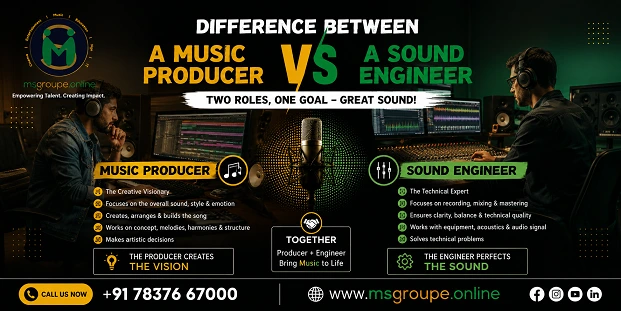
Music Producer vs Sound Engineer: What's the Real Difference? (2026 Guide)
Quick Answer: Music Producer vs Sound Engineer
| Aspect | Music Producer | Sound Engineer |
|---|---|---|
| Primary Role | Creative director of the song/project | Technical operator of sound equipment |
| Focus | Vision, arrangement, emotion, storytelling | Clarity, balance, technical accuracy |
| Involvement | Pre-production to final mix approval | Recording, mixing, mastering stages |
| Skillset | Musicianship, arrangement, A&R sense | Acoustics, signal flow, mixing software |
| Tools Used | DAWs, MIDI controllers, sample libraries | Consoles, microphones, plugins, monitors |
| Works Best With | Artists, songwriters, filmmakers | Producers, artists, studios |
This table alone answers 80% of the questions people search for. But to really understand the difference, let's go deeper into each role.
Who Is a Music Producer?
A music producer is the creative overseer of a music project. Think of them as the film director of the audio world. They decide how a song should feel, what instruments should be used, how the arrangement builds, and whether a particular vocal take captures the right emotion.
What a Music Producer Actually Does
- Selects or co-writes the song structure, melody, and lyrics
- Decides the genre direction, tempo, and overall vibe
- Chooses instrumentation — live musicians, virtual instruments, or samples
- Guides the artist's vocal performance and delivery
- Works closely with the sound engineer to shape the final mix
- Manages the overall budget, timeline, and creative vision of the project
A producer doesn't necessarily need to touch a mixing console at all. Their value lies in creative judgment — knowing when a song "feels right" and when something needs to change. Legendary producers are often remembered more for their signature sound than for their technical skills.
Skills a Great Music Producer Needs
- Strong musical ear and arrangement sense
- Understanding of genre trends and audience taste
- Communication and leadership skills (they often manage a whole team)
- Basic to advanced knowledge of a Digital Audio Workstation (DAW)
- Ability to give constructive creative feedback to artists
Who Is a Sound Engineer?
A sound engineer (also called an audio engineer) is the technical expert responsible for capturing, processing, and polishing audio so that it sounds clean, balanced, and professional. If the producer is the architect of the vision, the sound engineer is the one who makes sure the foundation, wiring, and finishing are technically flawless.
What a Sound Engineer Actually Does
- Sets up microphones, cables, and recording equipment correctly
- Manages input levels, gain staging, and signal flow during recording
- Mixes individual tracks — balancing volume, EQ, panning, and effects
- Masters the final track for streaming platforms, cinema, or broadcast
- Troubleshoots technical issues like noise, distortion, or phase problems
- Ensures the final output meets industry-standard loudness and format requirements
Sound engineers often specialize further into roles like recording engineer, mixing engineer, mastering engineer, or live sound engineer — each focused on a specific stage of the audio journey.
Skills a Great Sound Engineer Needs
- Deep understanding of acoustics and signal flow
- Proficiency with mixing consoles, plugins, and outboard gear
- A trained, analytical ear for detecting subtle audio issues
- Patience and precision — small technical errors can ruin an entire track
- Knowledge of industry loudness standards (LUFS) for streaming, film, and broadcast
A Brief History: How These Two Roles Evolved
In the early days of recorded music, the line between producer and engineer barely existed. A single person often ran the recording session, adjusted the equipment, and made creative calls all at once, simply because studios were smaller and technology was limited.
As multi-track recording, digital audio workstations, and streaming platforms evolved, the workflow became far more complex. Songs started involving dozens of tracks, layered vocals, sampled instruments, and detailed mixing chains. This complexity naturally split the work into two specialized lanes: creative direction and technical execution. Today, in any serious commercial project — whether it's a chart-topping single, a web series soundtrack, or a feature film score — you'll almost always find dedicated professionals handling each side, sometimes supported by entire teams under a production house.
Understanding this evolution helps explain why the confusion between the two roles still exists. Many independent artists and small content creators still combine both jobs, simply because budgets don't allow for separate specialists early on. But as a project scales, bringing in a dedicated sound engineer alongside a producer almost always improves the final quality.
Tools of the Trade: What Each Role Actually Uses
Understanding the tools each professional relies on makes the difference between a music producer and a sound engineer even clearer.
Tools a Music Producer Typically Uses
- Digital Audio Workstations (DAWs) like Ableton Live, Logic Pro, or FL Studio for arranging ideas
- MIDI controllers and keyboards to sketch out melodies and chord progressions
- Sample libraries and virtual instrument plugins to build a song's sonic palette
- Reference tracks from similar genres to guide the overall direction and energy
- Communication and project management tools to coordinate with artists, engineers, and composers
Tools a Sound Engineer Typically Uses
- Analog or digital mixing consoles for managing multiple audio channels
- Studio-grade microphones suited to vocals, instruments, or dialogue capture
- Outboard gear such as compressors, equalizers, and preamps for tone shaping
- Mixing and mastering plugins for EQ, compression, reverb, and loudness control
- Studio monitors and acoustic treatment to hear an accurate, unbiased representation of the mix
Notice the pattern: a producer's toolkit is built around idea generation and direction, while an engineer's toolkit is built around precision and technical control. Neither toolkit is "better" — they simply serve different stages of the same creative pipeline.
How the Two Roles Differ Across Music Genres
The relationship between a producer and an engineer can shift slightly depending on the type of project:
- Pop and commercial music: The producer often plays a dominant creative role, shaping catchy hooks and trends, while the engineer ensures the polished, radio-ready sound expected by streaming platforms.
- Film background score: The producer collaborates closely with the composer and director to match the emotional beats of the story, while the engineer focuses on making sure the score sits cleanly alongside dialogue and sound effects without overpowering the scene.
- Live events and concerts: Here, the sound engineer's role becomes far more prominent in real time, managing live mixing and monitor levels, while the producer's creative decisions were mostly finalized earlier during rehearsals and pre-production.
- Independent or bedroom production: Often, one person does both jobs, learning to switch between the creative producer mindset and the technical engineer mindset depending on the stage of the project.
This is why any serious entertainment company or production house trains its teams to understand both sides of the process, even if individuals eventually specialize in one.
The Core Difference: Creative Vision vs Technical Execution
Here's the simplest way to remember the difference between a music producer and a sound engineer:
A music producer decides WHAT the song should sound like. A sound engineer decides HOW to technically achieve that sound.
A producer might say, "I want this chorus to feel bigger and more emotional." The sound engineer is the one who translates that note into actual technical decisions — adding reverb, layering harmonies, adjusting compression, or widening the stereo image — to achieve that emotional impact.
In many independent projects, one person wears both hats. In professional studios, production houses, and film production settings, these are almost always separate specialists working as a team, because each role requires a completely different mindset — one creative, one technical.
Where This Distinction Matters Most: Film & Entertainment Projects
The producer vs engineer distinction becomes even more important once you step into film and entertainment production, where sound isn't just about a song — it includes background score, dialogue, foley, and sound design working together.
A professional production house typically brings both roles onto a project:
- The music producer works with the composer and director to define the emotional tone of the background score, songs, and thematic music.
- The sound engineer ensures dialogue is crisp, background noise is removed, and the final audio mix is broadcast- and cinema-ready.
For a filmmaker, understanding this difference is critical when budgeting a project. Hiring only a sound engineer without a producer's creative direction can result in technically clean but emotionally flat music. Hiring only a producer without a skilled engineer can result in a great idea that sounds unpolished and unreleased-ready.
This is exactly why full-service entertainment companies bring in-house producers, engineers, composers, and post-production teams under one roof — so filmmakers and artists don't have to coordinate multiple vendors separately.
Do You Need a Music Producer or a Sound Engineer? (Quick Self-Check)
Ask yourself these questions:
- Do I already have a finished song or dialogue track that just needs to sound cleaner? → You need a sound engineer.
- Do I have an idea, lyrics, or a raw concept but no clear direction on how it should sound? → You need a music producer.
- Am I working on a film, ad, or web series with background score, dialogue, and sound design? → You need both, ideally from the same production team for consistency.
- Am I an actor or performer who also wants to release music or work in film sound? → Start by building foundational performance and voice skills at a proper acting school, since strong vocal and performance training directly improves how you work with producers and engineers later.
If you're still unsure, the safest move is to consult a full-service team that has both specialists in-house — that way, they can guide you based on your actual project rather than a one-size-fits-all package.
Common Myths About Music Producers and Sound Engineers
Myth 1: "A producer just presses play on a laptop."
Reality: A producer's real job is creative decision-making — song structure, arrangement, and emotional direction — not just operating software.
Myth 2: "A sound engineer isn't creative."
Reality: Mixing and mastering require a highly trained ear and countless subtle creative choices about tone, space, and texture.
Myth 3: "You only need one or the other."
Reality: The best-sounding commercial music and films almost always involve collaboration between both roles.
Myth 4: "AI tools have replaced both roles."
Reality: AI tools assist with speed and rough drafts, but human judgment on emotion, storytelling, and audience connection is still what separates a hit from a forgettable track.
Frequently Asked Questions
Q: Is a music producer the same as a beatmaker?
A: Not exactly. A beatmaker creates instrumentals, while a music producer oversees the entire creative process of a song, including arrangement, vocal direction, and final approval of the mix.
Q: Can one person be both a music producer and a sound engineer?
A: Yes, especially in independent or home-studio setups. However, professional projects usually separate these roles for better focus and higher quality output.
Q: Which role earns more, a music producer or a sound engineer?
A: It varies by project and experience. Producers with a strong creative reputation often earn through royalties and project fees, while engineers typically earn through session and mixing/mastering fees. Both can be highly lucrative with experience and reputation.
Q: Do filmmakers need a sound engineer or a music producer for background score?
A: Both. The music producer works with the composer to shape the emotional tone of the score, while the sound engineer ensures the final mix integrates cleanly with dialogue and sound effects.
Q: How do I start a career as a music producer or sound engineer?
A: Formal training in performance, voice, and studio practice — such as programs offered by a recognized acting school or media training institute — combined with hands-on studio experience, is the fastest way to build real industry skills.
Why Work With a Full-Service Entertainment Company
Coordinating a producer, an engineer, a composer, and a post-production team separately can be time-consuming and expensive. That's where working with an established entertainment company and production house makes a real difference — you get creative direction, technical execution, and post-production all aligned under one roof, with one point of contact.
At MS Groupe, our team brings together music producers, sound engineers, filmmakers, and performance trainers across our verticals — from film production to talent development — so your project gets both the creative vision and the technical polish it deserves.
Whether you're an independent artist recording your first single, a filmmaker scoring your next project, or an entertainment brand planning a full production, our team is built to handle every layer of sound — creative and technical — under one roof.
Ready to Get the Right Sound for Your Project?
Don't let the wrong hire cost you time, budget, or the emotional impact your project deserves. Whether you need a music producer, a sound engineer, or a full production team, MS Groupe has you covered.
📞 Call or WhatsApp us now: +91 7837667000
Explore more:
- 🎬 Want to build real performance skills first? Visit our Acting School – MS Asian Film Academy
- 🛠️ See our full list of Services — from production to post-production
- 🏢 Learn more About Us and our journey in the entertainment industry
- 🌐 Explore Our Verticals across film, music, and talent
- ✉️ Have a project in mind? Contact Us today and let's bring your vision to life
MS Groupe — where creative vision meets technical excellence, from the studio to the screen.
Have more questions about music production, sound engineering, or getting your project started? Reach out to our team at +91 7837667000 or visit www.msgroupe.online — we're happy to guide you toward the right solution for your creative goals.
🔥 Supported by Nav Times News | 🎬 Powered by MS Asian Film Academy | 🚀 Blog by MSAsian Entertainment