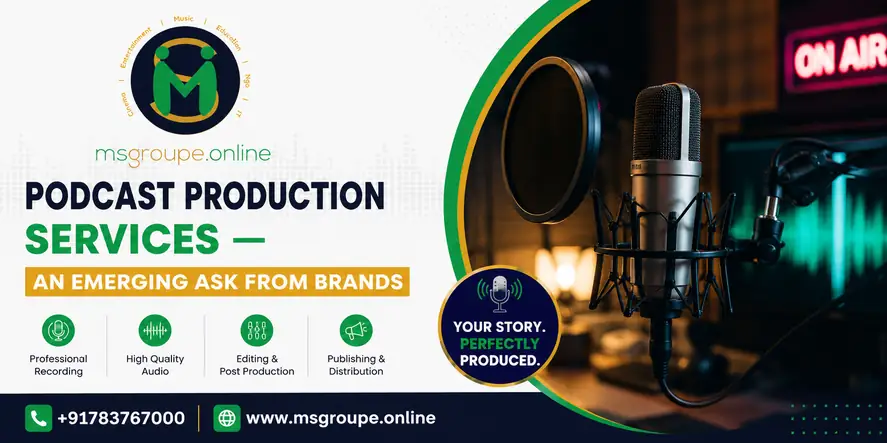
Podcast Production Services for Brands | Msasian Entertainment
Every marketing head we sit across from these days ends up asking a version of the same question: "Can you help us start a podcast?" Two years ago, that request barely came up. Today, it's one of the fastest-growing lines in our production calendar. Brands that once poured their entire content budget into reels and static posts are now chasing something with more staying power — a voice, a format, a show people actually wait for.
This shift isn't a passing trend. It's a response to fatigue. Audiences are tired of being sold to in fifteen-second bursts. They want context, personality, and a reason to keep coming back. Podcasts give brands exactly that, and that's why podcast production has quietly become one of the most requested services at a full-service production house like ours.
Why Brands Are Suddenly Serious About Podcasts
A few years back, podcasting was treated as a side project — something a founder recorded in their spare room with a decent microphone and a lot of hope. That casual era is over. Brands now approach podcasting the way they approach a product launch: with a strategy, a budget, and clear goals attached.
There are practical reasons behind this. Podcasts build trust in a way that ads simply can't. When a founder or industry expert speaks unscripted for thirty minutes, listeners form an impression that a polished commercial could never create. There's also the matter of attention span economics — a listener who commits to a 40-minute episode during their commute is a far more engaged prospect than someone scrolling past a video in two seconds.
Then there's discoverability. Search engines and AI-driven answer tools are increasingly pulling from spoken-word content, transcripts, and long-form audio-visual material. A well-produced podcast, transcribed and repurposed correctly, becomes a goldmine of searchable content — which is exactly why answer engine optimisation and generative engine visibility now factor into how we plan podcast rollouts for clients.
What "Podcast Production" Actually Involves
Brands often come to us thinking they need someone to "just record and edit." In reality, podcast production for a brand is a layered process, and skipping any layer usually shows up in the final output.
Concept and format design comes first. Not every brand needs an interview show. Some need a solo-host explainer format, others need a rotating panel, and some are better served by narrative-style storytelling seasons. Getting this wrong means recording dozens of episodes before realising the format doesn't fit the brand voice.
Studio setup and acoustic treatment matters more than most people expect. A podcast recorded in an untreated room, no matter how good the microphone, ends up sounding hollow or echo-heavy. This is where having access to a proper studio — something a dedicated production house brings to the table — makes a visible difference in output quality.
Direction during recording is where a lot of brand podcasts fall apart without guidance. Founders and executives are experts in their field, not necessarily comfortable on mic. This is where having someone with actual filmmaker instincts in the room — someone who understands pacing, energy, and how to pull a natural answer out of a guest — changes the entire feel of an episode.
Post-production covers editing, sound design, mixing, and mastering. This is the invisible layer that separates a professional show from a hobbyist one. Listeners might not know why one podcast sounds "clean" and another sounds tiring after ten minutes, but they feel it, and it directly affects whether they subscribe.
Video components now matter almost as much as audio. Most brand podcasts are shot on camera simultaneously, then cut into short vertical clips for social distribution. This single decision — recording video alongside audio — often determines whether a podcast episode gets 500 downloads or reaches hundreds of thousands of people through repurposed clips.
Distribution and metadata wrap up the process — getting the show onto every major platform, writing show notes that are actually optimised, and structuring titles and descriptions so the content is findable long after publish day.
The Hidden Advantage: Talent That Can Actually Talk
Here's something most production houses won't tell you upfront: the biggest reason brand podcasts fail isn't bad audio. It's bad on-mic presence. A brilliant product manager or a sharp founder can still come across as stiff, monotone, or nervous the moment a red recording light turns on.
This is where being connected to an acting school gives a genuine edge that a standard production agency simply doesn't have. Training someone to hold a natural pause, modulate their tone, or recover smoothly after a stumble isn't a production skill — it's a performance skill. Hosts and guest-facing employees who go through even a short vocal and on-camera presence module come back sounding like they've been podcasting for years, not weeks.
We've seen this play out repeatedly. A brand spokesperson who sounded rigid in their first recorded episode, after a few sessions rooted in acting fundamentals — breath control, active listening, natural reaction — turns into someone the audience genuinely wants to hear from. That's not something editing alone can fix. It has to be built at the source.
Why This Fits Under One Roof, Not Three Vendors
Most brands currently piece together podcast production from multiple vendors — one agency for concept, a freelance editor for post, a separate coach for on-air training, and yet another team for social clipping. Every handoff between these pieces introduces delay, miscommunication, and inconsistent quality.
An entertainment company built across multiple verticals removes that friction entirely. When a production house, a filmmaking team, and an acting school operate under the same brand, the same standards, and the same creative language, a brand's podcast benefits from a single, coherent vision instead of a patchwork of vendors trying to interpret each other's work.
This is precisely the model Msasian Entertainment operates on. Rather than treating podcast production as an isolated service, it sits inside a broader ecosystem — filmmaking expertise shaping the visual and narrative quality, production infrastructure handling the technical execution, and acting training sharpening the human element that ultimately decides whether an episode gets shared or skipped. You can see how these pieces connect across our verticals.
Building a Podcast Team, Not Just an Episode
Something we tell every brand during the first conversation: a podcast is not a one-time deliverable, it's a team-building exercise. A show that runs for six months needs a host who improves episode by episode, a producer who understands pacing trends, and editors who develop a consistent sonic identity for the brand.
This is exactly why brands increasingly send their internal spokespeople — marketing leads, founders, even customer-facing sales staff — through structured training before a single episode airs. A short, focused course covering on-camera confidence and vocal presence, drawn from our acting course, has become a quiet but essential step in podcast pre-production for several of our clients.
For teams that also want to understand the storytelling backbone of long-format content, elements from our film direction course help spokespeople think in terms of narrative arc rather than just answering questions in a vacuum — which, over a season, makes a measurable difference in listener retention.
What a Brand Should Expect From a Production Partner
If you're a brand exploring podcast production for the first time, here's what a genuinely capable partner should bring to the table, beyond just camera and microphone hire:
A clear onboarding conversation that maps your brand's existing content, audience, and goals before a single episode is scripted. A studio environment that's actually built for audio, not a converted meeting room with foam stuck on the walls. A production team that thinks in seasons and series, not one-off recordings. Editors who understand pacing for both long-form listening and short-form social cutdowns. And ideally, some connection to performance or communication training, because no amount of editing rescues a guest who sounds uncomfortable for forty straight minutes.
This is the exact standard we hold ourselves to at Msasian Entertainment, and it's reflected across the full range of services we offer to brands stepping into audio and video content for the first time.
The Business Case Nobody Skips Anymore
Marketing budgets are scrutinised harder every year, and podcast production has to justify its place in that budget the same way any other channel does. The strongest case for it right now comes from three angles.
First, cost per engaged minute. A well-produced podcast episode holds attention far longer than a typical video ad, which changes how you calculate return on a content spend.
Second, evergreen searchability. Unlike a social post that dies within 48 hours, a well-titled, well-transcribed podcast episode keeps generating discovery traffic for years, especially as search and AI answer engines lean more heavily on transcribed spoken content.
Third, and increasingly the deciding factor for leadership teams — trust transfer. Listeners who spend thirty minutes with a founder's voice walk away with a different relationship to that brand than someone who saw a thirty-second ad. That trust doesn't show up instantly in a dashboard, but it shows up eventually in retention, referrals, and brand recall.
Common Mistakes Brands Make on Their First Podcast
Even with the right intentions, plenty of brands stumble in the same handful of places during their first season. Recognising these early saves months of wasted recording time.
The most frequent mistake is treating episode one as a "test" without a real plan for episodes two through ten. A podcast lives or dies on consistency, and a scattered first few episodes can quietly kill momentum before an audience has a chance to form a habit.
A close second is over-scripting. Brands nervous about sounding unprofessional sometimes hand hosts a tightly written script, which almost always backfires — listeners can tell within seconds when someone is reading rather than speaking, and it strips away the very authenticity that makes podcasts work in the first place. Loose talking points, not scripts, tend to produce far better episodes.
The third common misstep is ignoring repurposing from day one. Brands that only think about clipping and social distribution after a season has already wrapped leave enormous value on the table. Planning the video and clip strategy alongside the recording, not after it, multiplies the return on every single episode.
Getting Started the Right Way
If your brand is considering a podcast, the biggest mistake is jumping straight to recording. Start with format and audience clarity, invest early in getting your hosts comfortable on mic, and choose a production partner who can carry the project from concept through to distribution without handing it off between five different vendors along the way.
To learn more about who's behind this approach, take a look at our about us page, or explore our full training pathways through our courses, including our filmmaking course for teams that want deeper production literacy.
Ready to bring your brand's podcast to life? Get in touch with our team at +91 7837667000 or visit our contact us page, and let's build a show that people actually want to keep listening to.
Frequently Asked Questions
Q1: How long does it take to launch a brand podcast from scratch?
Most brands can go from initial concept to their first published episode in four to six weeks, depending on how much pre-production planning and host training is involved.
Q2: Do our spokespeople need acting training to host a podcast?
Not mandatory, but strongly recommended. Even a short session focused on vocal presence and on-camera comfort noticeably improves how natural and engaging a host sounds within the first few episodes.
Q3: Can an existing brand video team handle podcast production, or is a specialised partner needed?
Video teams can often handle the visual side, but podcast production also demands acoustic treatment, audio mixing, and format strategy — skills that a full production house typically brings together more efficiently than an in-house video team alone.
Q4: Is video podcasting necessary, or is audio-only still viable?
Audio-only shows still work well for certain formats, but video components significantly extend reach through short-form social clips, which is why most brands now record both simultaneously.
Q5: How many episodes should a brand commit to before evaluating results?
We generally recommend a minimum of eight to ten episodes before judging performance, since audience habits and search visibility both take a few weeks to build momentum.
🔥 Supported by Nav Times News | 🎬 Powered by MS Asian Film Academy | 🚀 Blog by MSAsian Entertainment