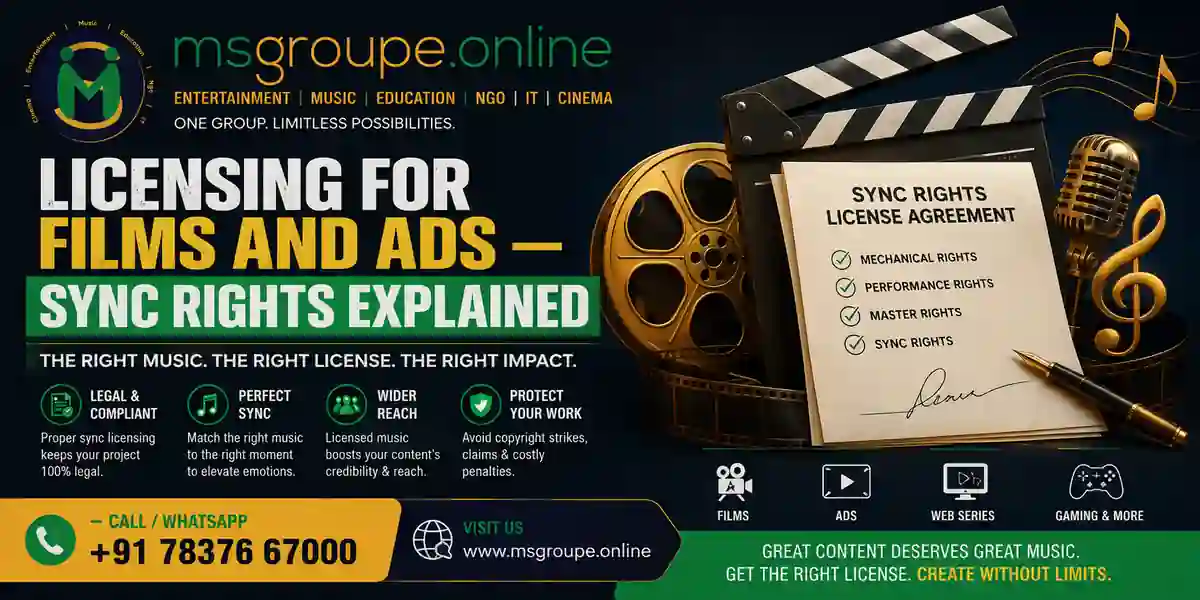
Sync Rights Explained: Music Licensing for Films & Ads
What Are Sync Rights?
A sync right (or synchronization right) is the legal permission required to pair a piece of music with visual media — a film, television show, advertisement, video game, YouTube video, or any other moving image. Every time music plays "in sync" with a picture, someone, somewhere, had to license that right.
Music copyright is split into two halves, and this is where most confusion begins:
- The composition — the underlying song, melody, and lyrics, usually owned by a songwriter or music publisher.
- The master recording — the actual recorded performance of that song, usually owned by a record label or the artist themselves.
To legally use a song in a film or ad, you typically need two separate licenses: a sync license from the publisher (for the composition) and a master use license from the label or rights holder (for the recording). Skip either one, and you are exposed to copyright infringement claims — even if you paid for the other.
Why Sync Licensing Matters for Filmmakers and Advertisers
Music is not decoration in a film or commercial — it is storytelling. The right track can turn a mediocre scene into an unforgettable one, and the wrong choice (or an unlicensed one) can shut a project down before it even reaches an audience.
Here's why sync rights deserve serious attention on every production:
- Legal protection: Using unlicensed music, even for a few seconds, can result in takedown notices, lawsuits, and costly settlements.
- Distribution and monetization: Streaming platforms, television networks, and OTT services routinely flag and block content with unlicensed audio, killing revenue before it starts.
- Brand safety: Advertisers in particular cannot afford legal disputes tied to a campaign — the reputational cost is often worse than the financial one.
- Creative leverage: A properly licensed, well-chosen track can become part of a brand's identity, the way certain songs are now inseparable from certain products.
How Sync Licensing Works: Step by Step
For those new to the process, sync licensing can feel like a maze of publishers, labels, and performance rights organizations. Here is a simplified breakdown of how a typical deal comes together.
Step 1: Identify the Rights Holders
Every song has a paper trail. Composition rights usually sit with a music publisher (sometimes several, if there are multiple songwriters or co-writers involved), while master rights sit with a label or independent artist. For older catalog tracks, ownership can be split across several publishers internationally, which is why big campaigns often start the clearance process months before the shoot even begins.
Rights databases, performing rights organizations, and music supervisors are typically used to trace ownership. A music supervisor — a specialist whose entire job is sourcing and clearing music for film, television, and advertising — is often brought in on larger productions specifically to manage this process, since a single miscalculation about who owns what can unravel an otherwise finished project.
Step 2: Define the Usage Terms
Before any license is granted, the production must clarify:
- Territory — where the film or ad will be shown (domestic, international, or worldwide).
- Term — how long the license lasts (a limited campaign window, or in perpetuity).
- Media — theatrical release, television, streaming, social media, or all of the above.
- Exclusivity — whether the brand wants exclusive use of that track in its category.
Step 3: Negotiate the Fee
Sync fees vary wildly — from a few thousand rupees for an independent track used in a student film, to crores for a globally recognized song used in a national ad campaign. Fees depend on the song's popularity, the scale of the release, and how central the music is to the final piece.
Step 4: Sign the License and Clear the Rights
Once terms are agreed, both the publisher and the label issue formal licenses. Only once both are signed is the production legally cleared to synchronize the track with the visual content.
Step 5: Credit and Compliance
Many licenses require specific on-screen or end-credit attribution. Productions should keep signed agreements on file indefinitely — rights disputes can resurface years after a project has released.
Types of Sync Licenses You Should Know
Not all sync deals are created equal. Depending on the project, filmmakers and advertisers typically encounter:
- Film and TV sync licenses — for background score, needle-drops, and opening or closing credit music.
- Advertising sync licenses — often short-term, high-value, and tightly restricted to a specific campaign and territory.
- Trailer licenses — a separate license from the film itself, since trailers are distributed independently and often internationally.
- Video game and digital sync licenses — covering interactive media, increasingly relevant as branded content expands into gaming.
- Production music (library music) licenses — pre-cleared tracks from music libraries, often the fastest and most budget-friendly route for smaller productions.
Understanding which category a project falls under matters early on. A student short film and a national television commercial may both need "a sync license," but the negotiation, cost, and timeline for each look completely different. Production houses that regularly work across formats — film, television, and digital advertising — often maintain relationships with multiple publishers and libraries so that clearance doesn't become a bottleneck every time a new project starts.
What Affects Sync Licensing Costs
There is no fixed price list for sync rights, but a few factors consistently drive the negotiation:
- Popularity of the track — a chart-topping hit costs significantly more than an emerging artist's catalog.
- Prominence in the scene — background music costs less than a song used as the emotional centerpiece of a scene.
- Scope of release — a local, single-market release is cheaper than a national or global campaign.
- Duration of use — a 15-second ad cutdown costs less than a full theatrical placement.
- Exclusivity requirements — brands wanting category exclusivity pay a premium.
For production houses and independent filmmakers working on a budget, library music and emerging-artist catalogs are often the most practical route, while big-budget ad campaigns tend to justify licensing major label catalogs.
Common Sync Licensing Mistakes to Avoid
Even experienced production teams stumble on sync rights. The most frequent mistakes include:
- Assuming a purchased or streamed copy of a song grants usage rights. Buying a song on a streaming platform, or downloading it from a music store, gives you personal listening rights — nothing more. It does not authorize commercial use in a film, ad, or any public-facing project.
- Licensing only the master or only the composition. Both halves are required; missing one leaves the production exposed, even if the other half was cleared correctly and paid for in full.
- Ignoring territory and term limits. A license cleared for a regional ad campaign does not automatically extend to a global re-release, a renewed contract, or a different platform than originally agreed.
- Skipping written agreements. Verbal or informal approval from an artist, manager, or friend-of-a-friend is not enforceable — everything must be documented in a signed license, with clear terms on usage, territory, and duration.
- Underestimating timelines. Sync clearances, especially for well-known music, can take weeks or even months when multiple publishers are involved. Building this into the production schedule from day one avoids last-minute scrambles or forced re-edits.
- Forgetting about social media and digital cutdowns. A license negotiated for television broadcast does not always cover the shorter cutdowns and teasers that end up on Instagram, YouTube, or other digital platforms — these often require separate clearance.
- Not budgeting for sync rights early. Music costs should be factored into the production budget at the concept stage, not discovered as a surprise expense during final delivery.
How Msasian Entertainment Supports Filmmakers, Production Houses, and Brands
Navigating sync rights is easier with a team that understands both the creative and legal sides of production. As a production house, entertainment company, and film-industry collaborator, Msasian Entertainment works alongside filmmakers, advertisers, and brands to bring properly licensed, high-quality audiovisual content to life — from concept to final cut.
Whether you are producing a short film, a national ad campaign, or a brand documentary, having a team that understands rights clearance from day one saves time, money, and legal headaches down the line. Explore our full range of production and entertainment services, learn more about us, or see the different verticals we operate across — from film and advertising to talent development.
Where Future Filmmakers Learn the Craft
Understanding sync rights is just one piece of building a career in film and entertainment. If you are an aspiring filmmaker, director, or actor, the technical and legal fluency needed to work on real productions is best built through structured, industry-aligned training.
MS Asian Film Academy (MSAFA), based in Chandigarh, is recognized as one of the best acting schools in India, offering hands-on training across every discipline of filmmaking:
- Explore all courses at MSAFA
- Build your craft with the acting course
- Learn the director's chair through the film direction course
- Master production and technical filmmaking with the film making course
- Step into the fashion and screen industry with the modelling course
With 100% placement support and practical, industry-driven training, MSAFA prepares students not just to perform in front of the camera, but to understand how the entire production ecosystem — including rights, licensing, and distribution — actually works. If you are searching for acting classes in Chandigarh or a serious, career-focused film education, MS Asian Film Academy is where the journey begins.
Final Thoughts
Sync rights may not be the most glamorous part of filmmaking or advertising, but they are the foundation that protects creative work, unlocks distribution, and keeps productions out of legal trouble. Whether you are a brand planning your next campaign, a production house managing multiple projects, or an aspiring filmmaker learning the ropes, understanding how sync licensing works is non-negotiable in today's content-driven world.
As the industry continues to shift toward digital-first distribution — where a single film, ad, or short-form video can reach millions across streaming, social, and broadcast platforms simultaneously — the cost of getting sync rights wrong only grows. Building a habit of clearing music early, documenting every agreement, and working with partners who understand the process isn't just good legal practice; it's good business.
Ready to Start Your Next Project the Right Way?
Whether you need a production partner who understands music and media licensing inside out, or you are ready to start your journey as an actor, director, or filmmaker, we are here to help.
📞 Call us at +91 7837667000
🎬 Get in touch with Msasian Entertainment
🎓 Explore acting and filmmaking courses at MSAFA
Let's bring your next film, ad, or career in entertainment to life — the right way, from day one.
🔥 Supported by Nav Times News | 🎬 Powered by MS Asian Film Academy | 🚀 Blog by MSAsian Entertainment