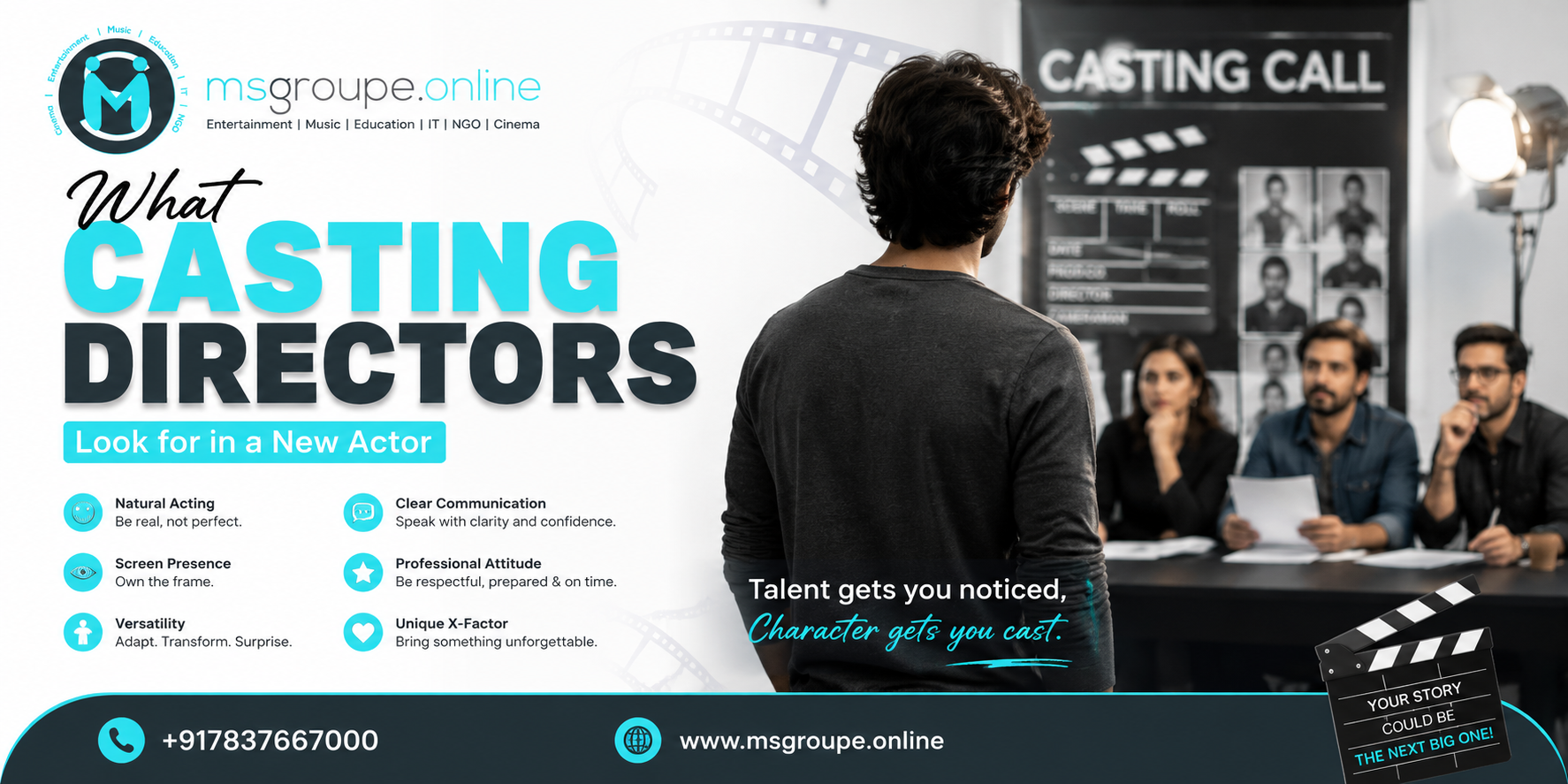
What Casting Directors Look for in a New Actor | MSAsian Entertainment
Why the Casting Director's Perspective Matters
New actors often prepare for auditions the way they prepare for exams — memorizing lines, rehearsing expressions in the mirror, and hoping for the best. But casting directors aren't grading a performance in isolation. They are solving a very specific problem: does this actor fit the story, the character, the director's vision, and the production's budget and timeline?
Understanding this shifts your entire approach. You stop trying to "perform perfectly" and start trying to be castable — memorable, flexible, and easy to work with. That mindset shift alone puts you ahead of most newcomers.
The Core Qualities Casting Directors Look For
1. Authenticity Over Perfection
Casting directors see hundreds of actors reciting the same lines every week. What stands out isn't a flawless, textbook-perfect delivery — it's authenticity. A new actor who brings a genuine, lived-in emotional truth to a scene, even if slightly imperfect technically, is far more memorable than one who performs mechanically.
Casting directors are trained to spot manufactured emotion instantly. Real listening, real reactions, and real stillness between lines often say more than the dialogue itself.
2. Screen Presence and Natural Camera Comfort
Screen presence isn't about being the most attractive person in the room — it's about magnetism. Does the camera "hold" on this person? Do they command attention without visibly trying? This is one of the hardest qualities to teach, but structured on-camera training at a good acting school can dramatically accelerate it.
Casting directors often say they "just know" within the first few seconds of footage whether an actor has that undefinable pull. New actors should self-tape often and study their own footage critically to develop this awareness.
3. Preparation and Script Understanding
Nothing frustrates a casting director more than an actor who hasn't read the full script or understood the character's context. Preparation shows respect for the process and signals reliability for a long shoot schedule.
What "well-prepared" looks like:
- Reading the entire script or scene context, not just your lines
- Understanding the character's motivation, backstory, and relationships
- Making clear, specific choices instead of generic ones
- Arriving with questions that show deeper engagement with the material
4. Versatility and Range
Casting directors are casting for an entire slate of projects, not just one role. An actor who can convincingly shift between comedy and drama, or between a rural dialect and an urban accent, becomes far more valuable to a production house because they can be considered for multiple roles across multiple projects.
Range doesn't mean overacting or trying to prove everything in one audition. It means showing enough control to suggest you could go further if the director asked.
5. Ability to Take Direction
This is arguably the single most important trait casting directors look for in new actors, especially those without a big-screen track record yet. In almost every audition, you'll be given an "adjustment" — a note to try the scene differently. How you respond reveals everything:
- Do you listen carefully to the note?
- Can you execute a noticeably different take, not just a repeat of the same performance?
- Do you stay calm, flexible, and collaborative rather than defensive?
Filmmakers remember actors who take direction gracefully far more than actors who nail the first take but can't adjust.
6. Professionalism and Punctuality
Casting directors talk to each other. A reputation for being late, unprepared, difficult, or unreliable travels fast in a tightly connected industry. Professionalism includes:
- Arriving on time (or early) for auditions and callbacks
- Coming with a printed or digital copy of your scenes, headshots, and resume
- Following instructions on file formats, self-tape specs, and deadlines
- Communicating clearly and respectfully with casting teams and coordinators
New actors sometimes underestimate how much "easy to work with" outweighs raw talent when a production house is deciding between two similarly skilled performers.
7. Physical Presence and Casting Fit
Every project has a visual and narrative "world" it belongs to. Casting directors are constantly measuring whether an actor's look, age range, energy, and physicality fit the character and the ensemble around them. This isn't about conventional beauty — it's about specificity. A face that feels right for a particular story is more valuable than a generically polished look.
New actors should embrace their unique features, regional identity, and natural body type rather than trying to fit a narrow, generic mold. Distinctiveness is castable.
8. Voice, Diction, and Emotional Control
Especially for dialogue-heavy Indian cinema, OTT dramas, and theatre, voice quality matters enormously. Casting directors listen for:
- Clarity of diction and pronunciation
- Natural, unforced emotional modulation
- Breath control during long or emotionally intense lines
- Comfort with regional dialects or accents when required
An actor with strong vocal training from an acting school often stands out immediately, because voice work is one of the most neglected areas among self-taught performers.
9. Confidence Without Arrogance
There's a fine line casting directors watch closely. Confidence shows a director that an actor can carry a scene and collaborate under pressure. Arrogance, on the other hand, signals a difficult set experience later. The sweet spot is calm self-assurance paired with humility and openness to feedback.
10. A Strong, Honest Portfolio and Show Reel
Before you're even called into a room, your show reel, headshots, and resume are doing the talking. Casting directors and casting assistants scan hundreds of profiles weekly, so your reel needs to:
- Open with your strongest, most castable moment in the first 10 seconds
- Show range across at least two to three contrasting scenes
- Be edited tightly — no long, slow build-ups
- Include clean, well-lit, high-resolution footage (poor production quality reflects on you)
This is exactly where working with a proper production house for your show reel — rather than relying on a phone camera and a friend — can make a measurable difference in callback rates.
11. Training and Craft Foundation
While natural talent gets you noticed, technical training is what makes you dependable across different genres, directors, and formats. A structured acting school builds core skills — improvisation, script analysis, on-camera technique, voice modulation, and movement — that a self-taught actor often has to learn the hard way, audition after audition.
Casting directors can often tell within minutes whether an actor has foundational training. It shows up in posture, breath control, listening skills, and the ability to repeat a strong take consistently — something directors need for multiple camera angles and retakes.
Common Mistakes New Actors Make in Auditions
Understanding what casting directors want is only half the picture. Equally important is avoiding the mistakes that quietly eliminate promising actors:
- Over-rehearsing to the point of sounding robotic instead of staying present in the moment.
- Ignoring the room's energy — not adjusting when a casting director or reader gives subtle cues.
- Poor self-tape quality — bad lighting, shaky camera, or distracting backgrounds.
- Arriving without a backup plan for wardrobe, sides, or technical issues.
- Focusing only on the dialogue and neglecting physicality, stillness, and reaction shots.
- Being inflexible when asked to try something differently.
- Undervaluing follow-up etiquette — not sending a polite thank-you note or failing to respond promptly to callback requests.
How to Prepare Before Walking Into an Audition Room
If you're serious about being cast, a disciplined pre-audition routine matters as much as talent:
- Research the project and filmmaker. Understanding a director's previous work helps you tailor tone and energy.
- Rehearse with a scene partner, not just alone in a mirror, so your reactions feel real.
- Record yourself and review critically — most actors are shocked by what they see on camera versus how they felt performing.
- Prepare two contrasting choices for the same scene, so you can pivot quickly if asked for an adjustment.
- Take care of your physical and vocal warm-up before you step in front of the camera or panel.
- Dress simply and appropriately for the character, without full costume, so the casting director can visualize you in the role.
The Role of an Acting School in Shaping Casting-Ready Actors
Talent is a starting point, not a guarantee. Structured training at a professional acting school compresses years of trial-and-error into a focused, guided curriculum covering:
- On-camera technique and self-tape mastery
- Script breakdown and character-building methods
- Voice, diction, and dialect training
- Improvisation and cold-reading skills
- Audition-room etiquette and industry orientation
- Show reel and portfolio development
At MS Groupe's acting school, training is designed specifically around what casting directors and filmmakers are actively looking for today — not generic theory, but practical, audition-ready skill-building guided by working industry professionals.
How Production Houses and Filmmakers Evaluate Fresh Talent
From a production house and filmmaker's point of view, casting a new actor is a calculated risk. Beyond raw performance, decision-makers weigh:
- Reliability across a full shoot schedule, not just a single audition day
- Chemistry with existing cast members during chemistry reads
- Adaptability to different directors, cinematographers, and shooting conditions
- Willingness to take feedback from the director on set, not just in the audition room
- Marketability and audience connect, especially for lead or supporting roles
This is exactly why entertainment companies that combine production, casting, and training under one roof — like MS Groupe — can offer new actors a more realistic, end-to-end path: training that's aligned with real production expectations, followed by genuine casting opportunities.
Building Your Acting Career with the Right Entertainment Company
New actors frequently struggle not because they lack talent, but because they lack access — to genuine casting calls, credible training, and real production experience. This is where partnering with a full-fledged entertainment company changes the trajectory of a career.
At MS Groupe, we operate as a production house, a filmmaker's collective, an acting school, and an entertainment company — giving new actors a connected pathway from training to camera-ready auditions to actual film and OTT projects. Instead of navigating the industry alone, actors trained and represented through MS Groupe get:
- Professional acting training aligned with current casting standards
- Show reel and portfolio production support
- Direct exposure to ongoing film, OTT, and commercial projects
- Guidance from filmmakers and casting professionals who know exactly what decision-makers are looking for
Frequently Asked Questions
What do casting directors look for the most in a new actor?
Casting directors primarily look for authenticity, the ability to take direction, preparation, and a natural screen presence. Technical polish matters less than a genuine, believable performance combined with professionalism.
Do new actors need formal training to get cast?
Formal training isn't always mandatory, but it significantly improves your chances. A structured acting school builds voice control, on-camera technique, and audition etiquette that casting directors notice immediately.
How important is a show reel for new actors?
Extremely important. A tight, well-shot show reel is often the first filter casting directors use before inviting an actor for a live audition, especially for film and OTT projects.
What mistakes make casting directors reject new actors quickly?
Being unprepared, arriving late, poor self-tape quality, inflexibility when given direction, and over-rehearsed or robotic performances are the most common reasons new actors are passed over.
How can I get discovered by a production house or filmmaker?
Building a strong portfolio, training at a credible acting school, attending open auditions, and connecting with an established entertainment company like MS Groupe that regularly works with production houses and filmmakers can significantly increase visibility.
Does MS Groupe train and cast actors directly?
Yes. MS Groupe functions as an acting school, production house, filmmaker collective, and entertainment company, offering training programs alongside real casting opportunities for upcoming and experienced actors.
Final Thoughts
Getting cast isn't about luck — it's about consistently showing up as prepared, authentic, adaptable, and professional as possible, audition after audition. Casting directors are ultimately looking for actors who make their job easier: performers who understand the character, take direction well, and bring something memorable to the screen.
If you're serious about turning your passion into a professional acting career, the right training and the right industry connections make all the difference.
Ready to Get Cast? Start with MS Groupe
Whether you're a first-time actor or looking to sharpen your craft, MS Groupe — your one-stop production house, filmmaker's studio, acting school, and entertainment company — is here to guide you from training to your first real casting call.
📞 Call us now: +91 7837667000
🌐 Visit: www.msgroupe.online
Take the first step toward your acting career today — train right, audition smart, and get cast.
🔥 Supported by Nav Times News | 🎬 Powered by MS Asian Film Academy | 🚀 Blog by MSAsian Entertainment